
by Daniel Minden
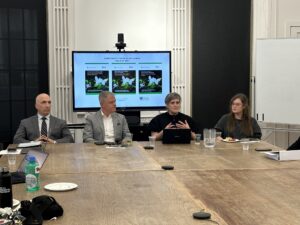
On March 26, 2026, the Asper Centre formally launched its new Practical Guide to Police Oversight, a resource designed to help people in Ontario navigate Ontario’s police complaints system. To mark the occasion, the Asper Centre held an event which brought together Jackman Law students and staff, representatives from several Toronto legal clinics, and officials from police oversight agencies. The event featured remarks from Joseph Maiorano, Deputy Inspector General of Policing of Ontario; Stephen Leach, Complaints Director at the Law Enforcement Complaints Agency (LECA); Emily Hill, Senior Staff Lawyer at Aboriginal Legal Services; and Sarah Strban, a criminal defence lawyer in Toronto.
In her introductory remarks, Tal Schreier, Program Coordinator at the Asper Centre, noted that the Police Complaints Guide project originated in 2017. During the summer of 2017, Sarah Strban, then a student at the Faculty of Law, worked as a researcher for renowned Canadian constitutional law expert Mary Eberts in the context of the National Inquiry into Missing and Murdered Indigenous Women and Girls. Her research uncovered a lack of public information about the police complaints process in Canada. Following her summer fellowship, Strban convened an Asper Centre working group which carried on with this research. In response to Sarah’s working group research, the Asper Centre sought and received funding from the Law Foundation of Ontario (LFO) to create the guide. However, the newly elected provincial government led by Doug Ford was in the midst of altering the police oversight legislative framework. In 2019, the Legislative Assembly of Ontario passed the Community Safety and Policing Act (“CSPA”) which reformed the province’s police complaints system. The Asper Centre paused the project until the CSPA entered into force and was fully implemented. With the new police complaints system in effect as of 2024, the Asper Centre completed the drafting and translations of the guide in 2025.
The guests of honour lauded the guide as a valuable resource for the public and explained their organizations’ roles in Ontario’s new police oversight system. Joseph Maiorano, Deputy Inspector General of Policing, noted that the Inspectorate’s mandate is to ensure the compliance of police services and boards with the CSPA. The Inspectorate achieves this task through inspections, investigations, and advisory services, Maiorano said. To fulfil its mandate, the Inspectorate is empowered to issue compliance directions, remove members of a police services board, and appoint administrators to administer a police service. The Inspectorate also includes a Centre of Data Intelligence and Innovation, which conducts research and analysis to improve policing in Ontario.
Maiorano also provided an update on the Inspectorate’s recent work, highlighting its inspection of the Thunder Bay Police Service and Thunder Bay Police Service Board. In addition, Maiorano underscored the Inspector General’s recent decision to launch an inspection of police integrity and anti-corruption practices across Ontario, which will examine five areas: supervision of officers, vetting of recruits and officers, access to databases, evidence management, and substance use related to fitness for duty.
The event also featured remarks from Stephen Leach, Complaints Director at LECA. Although members of the public can submit complaints about police conduct directly to LECA, these complaints are usually referred to the police service whose employees’ conduct is at issue. LECA itself rarely decides to retain complaints for investigation. Rather, LECA functions as an independent oversight body which is set up to review results of investigations conducted by police agencies. LECA can confirm or modify these results or order new investigations.
Leach argued that LECA has made substantial progress in remedying the shortcomings of its predecessor organization, the Office of the Independent Police Review Director (OIPRD), which existed until April 2024. According to Leach, the OPIRD had a backlog of 1,000 cases. Leach claimed that LECA has improved those metrics significantly and is now complying with the 120-day limit set out in the CSPA. Leach also lauded the provision in the CSPA which requires police chiefs to advise LECA of possible incidents of misconduct affecting the public and claimed that LECA receives 10-15 such notifications per week.
Following the remarks by Leach, Emily Hill of Aboriginal Legal Services (ALS) explained that her organization frequently helps clients address police misconduct. According to Hill, ALS often represents families in inquests following deaths of individuals in police custody or use-of-force incidents. ALS also assists clients in making complaints about police through the LECA process, filing human rights complaints where discriminatory police conduct is at issue, and contacting police to report crimes. For Hill, the Police Complaints Guide is a valuable resource which will help people in Ontario understand their options for police complaints and inform Ontario residents about the outcomes that they can realistically expect. Hill also commented on the potential use of restorative justice practices in resolving police complaints, noting that they can be particularly effective where the parties have an ongoing relationship, a shared interest in continued collaboration, and a commitment to improving policing in the community.
Finally, Toronto criminal defence lawyer Sarah Strban, who worked on the Guide during her studies at the Faculty of Law, elaborated on the origins of the guide. Strban noted that her initial research into police oversight in Ontario was conducted for Mary Eberts, who served as counsel to the Women’s Legal Education and Action Fund (LEAF) at the National Inquiry into Missing and Murdered Indigenous Women and Girls. With the benefit of Strban’s research, Eberts asked the National Inquiry to expand its mandate to encompass police oversight. Although the National Inquiry declined to do so, Strban’s summer research became a “passion project” and led her to convene the student-led working group at the Asper Centre, which continued to examine the police complaints process. Now that the project has come to fruition, Strban believes that the guide will be a valuable resource for people in Ontario, in particular for those who cannot afford to hire a lawyer.
The Asper Centre’s Practical Guide to Police Oversight, funded by the Law Foundation of Ontario, is available online in English, French, and Oji-Cree [Anishininiimowin / ᐊᓂᐦᔑᓂᓃᒧᐏᐣ] and in print at many legal clinics across Ontario.
Daniel Minden is a Research and Communications Assistant with the Asper Centre. He is a 1L JD candidate at the University of Toronto Jackman Faculty of Law.