

by Olivia Parker
This summer, I had the privilege of being sponsored by the David Asper Centre for Constitutional Rights through the Yaremko Fellowship program to work with the Canadian Environmental Law Association (CELA) in Toronto. Founded in 1970, CELA is a legal aid clinic dedicated to advancing environmental justice for low-income Ontarians. Over its long history, CELA has been involved in significant cases such as representing residents of Walkerton during the 2000 drinking water tragedy, and ongoing litigation on behalf of citizens in Elliot Lake seeking a cleanup order for uranium waste used as backfill in their homes.
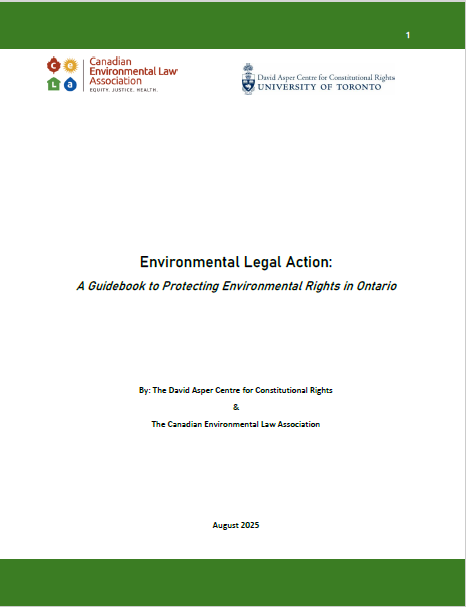
Asper Centre/CELA Environmental Legal Action Guide, 2025
During my time at CELA, I worked on several projects and researched a range of pressing environmental law issues. I helped finalize an Environmental Legal Action Guidebook created in partnership with the Asper Centre. This guide, which originated as an Asper Centre working group project, is a 73-page, five-chapter detailed resource designed for activists seeking to use Canadian law to advance environmental justice. It covers Ontario’s Environmental Bill of Rights, nuisance law, the Charter of Rights and Freedoms, Indigenous rights, and law reform strategies. I edited the Guidebook to make it more accessible and prepared it for publication. I hope it will be a practical tool for communities and advocates across Canada.
Early in the summer, I examined U.S. state-level environmental justice legislation to identify potential reforms for Ontario. I found examples from four states requiring developers to conduct cumulative impact assessments when proposing facilities in vulnerable communities—considering both the facility’s direct effects and existing environmental risks. These insights could guide similar proposals here in Ontario to strengthen environmental protections.
I also researched ways to improve environmental protections for migrant farm workers in Canada, many of whom face dangerous exposure to extreme heat and pesticides—both on the job and in employer-provided housing, which currently has no upper temperature limit. Drawing from U.S. and European statutes and advocacy initiatives, I developed recommendations including “right-to-know” pesticide hazard laws and an upper temperature standard for housing.
CELA, in partnership with the Canadian Association of Physicians for the Environment, recently released a poster outlining how recipients of Ontario Disability Support Program (ODSP) or Ontario Works (OW) can apply for funding for air conditioning units. Although funding is discretionary and requires a doctor’s note, we received numerous reports of applicants being denied despite meeting the medical requirement. I contacted multiple ODSP/OW offices across Ontario to gather information on how municipalities allocate this funding—research that could help shape future law reform.
In Ontario, public health units are required to identify populations particularly vulnerable to climate change and develop strategies to reduce these impacts. Of the 29 health units in the province, 17 have completed such assessments. I reviewed these assessments to produce a report highlighting vulnerable communities across Ontario. Consistently, children, seniors, and people of low socioeconomic status were identified as most at risk. Many health units also highlighted those who are chronically ill, Indigenous peoples, and newcomers to Canada. CELA intends to use these findings to inform policy recommendations that will better support these groups as climate change impacts intensify.
I am deeply grateful to the Asper Centre and CELA for making this experience possible. Over the summer, I developed my legal research and writing skills while engaging with complex and urgent issues in environmental law. I highly recommend this fellowship to other law students and look forward to continuing my work in environmental and constitutional law.
Olivia Parker is a rising 2L JD Candidate (2027) at the Faculty of Law and was the Asper Centre fellow at CELA this summer.