
R v Bird: Do Not “Breach First, Challenge Later”

by Sahil Kesar

Spencer Bird (“Bird”), a long-term offender, was charged with breaching the conditions of a community supervision order prescribed by the Parole Board. At the criminal proceeding, he sought to use the defence that the order which imposed his parole conditions was unconstitutional as they violated Section 7 of the Charter. He argued that the condition that he reside in a facility that was designated a penitentiary for the community portion of his sentence breached his right to liberty. At trial, Bird was successful only to have the decision overturned and to be convicted on appeal on the basis that he could not collaterally attack the parole condition in this manner. The Supreme Court of Canada (“SCC”) drew upon the doctrine of collateral attack based on the approach developed in R v Consolidated Maybrun Mines Ltd and R v Al Klippert Ltd to determine its applicability when the constitutionality of an administrative order is challenged collaterally, rather than appealed or judicially reviewed directly.

The majority dismissed the appeal on the basis that Bird was precluded from collaterally attacking the long-term supervision order (“LTSO”) prescribed by the Parole Board. Analyzing the factors of the Maybrun framework, Moldaver J determined that Parliament could not have intended to let offenders “breach first” and “challenge later” the LTSO conditions imposed on them by the Parole Board. Further, the availability of other options for Bird to pursue his constitutional rights favoured not allowing the collateral attack especially since Parliament intended to defer to the judgment of the Parole Board, given the wording of the legislative scheme. Moldaver J did find, however, that the final factor of the Maybrun framework favoured allowing the collateral attack; however, after weighing all the factors of the Maybrun framework, Moldaver J concluded that Parliament did not intend to have LTSO conditions collaterally attacked in the case at hand and dismissed the appeal.

Martin J, in a concurring opinion, also dismissed the appeal but on the basis that the LTSO conditions did not violate the Charter, concluding that Bird could collaterally attack the LTSO conditions imposed by the Parole Board in his defence. Martin J differed in her approach to the factors enumerated in the Maybrun framework. She was of the view that allowing a collateral attack does not amount to a “breach first, challenge later” approach since breaching LTSO conditions is not a strategic plan, especially since it could potentially lead to an additional 10-year sentence. Martin J also found that none of the options listed by the majority, which Bird could have sought instead of breaching his LTSO conditions, were adequate and intended by Parliament to use in this specific legislative scheme, particularly habeas corpus. She also found that the fifth factor weighed in favour of allowing the collateral attack.

Looking at the Charter arguments, Martin J dismissed the Section 9 and 11 arguments on the basis that this was not an exceptional case where she should hear Charter arguments not previously raised. On the Section 7 argument, Martin J disagreed with Bird’s arguments that the residency condition imposed on him was arbitrary. She found that the broad definition of penitentiary does not amount to him being forced to serve an arbitrary extension of his carceral sentence. She also found that the distinctions between other parolees and long-term offenders do not indicate that long-term offenders were not to be housed where Bird was being forced to reside. Ultimately, Bird’s residency condition was within the ability of the Parole Board to impose and was based on his particular circumstances.

The Asper Centre intervened in this appeal. The Centre made four submissions:

  1. First, the Asper Centre’s sought to have constitutional considerations made explicit in the Maybrun This was based on two assertions. First, Maybrun was not a constitutional case but the jurisprudence it drew on provided for the balancing of legislative intent against constitutional considerations. Particularly, the US jurisprudence points towards the idea that courts should not ignore a defendant’s constitutional rights or the practical availability of prescribed remedies when deciding whether to permit a collateral attack on an administrative order. Second, the Maybrun framework implicitly permits constitutional considerations. Since the framework is intended to protect the rule of law by determining the legislature’s intended forum for relief, it must do so in a way that encourages compliance with the constitution because the principle of constitutionalism requires state action to comply with the constitution. Divorcing Charter rights from the Maybrun framework creates a perverse situation where an administrative decision is neither rooted in law nor constitutionally compliant.
  2. Second, the Asper Centre sought to have the repute of the administration of justice included as an enumerated factor under the Maybrun Denying a collateral attack when Charter rights are at stake would bring the administration of justice into disrepute, as shown in certain other examples.
  3. Third, with emphasis on seeking judicial review in Federal Court, the Asper Centre sought to have access to justice considered in the Maybrun Judicial review in Federal Court is not timely or accessible for three reasons: 1) the requirement to exhaust complex and ineffective internal reviews; 2) the difficulty in obtaining deadline extensions in Federal Court; and 3) the protracted time period required to obtain judicial review.
  4. Fourth, allowing collateral attacks does not prejudice the Crown. There is no impact on the standard of review. The Crown asserted that allowing the collateral attack would distort the standard of review since constitutional questions would be considered under correctness instead of reasonableness. However, reasonableness would be applied under Dore, not correctness as they assert.

Moldaver J for the majority, asserted that the two principles that underlie the approach to collateral attacks on court orders are accounted for in the Maybrun framework for administrative orders. The framework adequately balances legislative intent with ensuring effective means for recourse to individuals challenging administrative orders. As such, this rejects the notion that constitutional considerations or the repute of the administration of justice (submissions one and two of the Asper Centre) need to be explicitly included since the framework already accounts for the rule of law and the repute of the administration of justice.

Moldaver J made reference to the Asper Centre’s third submission at paragraph 57. He accepted that there are realistic concerns over timeliness and accessibility of relief in Federal Court and that efficiency and timeliness are of greater importance when liberty is concerned. However, he held that Bird received notice of the Parole Board’s decision to impose residency conditions five months before his long-term supervision commenced, therefore giving him ample time to seek judicial review. Moldaver J stated that concerns about timeliness of judicial review was speculation and that Parliament might want to consider whether the procedures in place governing judicial review could be modified to provide more timely and accessible relief. However, he did not make access to justice a consideration in the Maybrun framework. Martin J, in her concurring opinion also accepted that Bird would have been unlikely to have the resources to secure counsel or self-represent himself for the purpose of navigating judicial review proceedings. She did consider the access to justice issues that this raises as the absence of an internal appeal process cannot mean Parliament intends individuals to navigate Federal Court.

Neither the majority nor the concurrence directly addressed the Asper Centre’s fourth submission.

Read the Asper Centre’s Factum in the Bird Appeal here.

Sahil Kesar is a 3L JD Candidate at the University of Toronto Faculty of Law and is currently the Asper Centre half-time Clinic student
Supreme Court Moves Voting Rights into Globalization Era in Frank Decision

by Jasmit de Saffel

In its first decision of the year, the Supreme Court of Canada sided with Canadian ex-pats in a case about their voting rights. Chief Justice Wagner held that “citizenship, not residence, defines our political community and underpins the right to vote” (para 35).

Frank v Canada had been initiated by two Canadians living in the United States after they were denied the right to vote in the 2011 federal election. Dr. Gill Frank and Mr. Jamie Duong live in the United States for work and educational purposes but maintain close ties to Canada. The impugned provisions of the Canada Elections Act held that citizens who had resided outside of Canada for more than five consecutive years were not able to vote in federal elections until they resumed residence in Canada. This provision was recently repealed by the government, and the Supreme Court decision has made the residence limitation on voting rights unconstitutional.

The application judge sided with the applicants in 2014, finding that the residence requirement infringes section 3 of the Charter and was not saved under section 1. On appeal to the Court of Appeal, the Attorney General of Canada conceded that the provision breached section 3 but argued that it was a justified infringement for the sake of the Canadian “social contract.” The appeal was allowed.

In his reasons Wagner CJ, writing for a 5-2 majority, emphasized that any intrusions on the core democratic right to vote must be reviewed on the basis of a stringent justification standard (para 25). He found that residence is not mentioned in the section 3 guarantee or established as essential to the right to vote in the jurisprudence. “The Charter tethers voting rights to citizenship, and citizenship alone” (para 29).

Under the section 1 analysis, Wagner CJ dismissed the Attorney General’s social contract argument as a vague and ill-suited objective to withstand the rigours of a section 1 justification. He quotes the Asper Centre’s factum in laying out the argument’s analytical failings, holding that using the social contract as an objective collapses any distinction between legislative means and ends (para 53).

The real downfall of the government’s case was at the minimal impairment stage. The Court held that the limit was over-inclusive and that no correlation had been shown between time lived abroad and subjective commitment to Canada. The Court held that we live in a globalized society and that the ability of citizens living abroad to remain connected to Canada is “unprecedented.” Non-residents, like the applicants, are able to maintain deep “political, familial, financial or cultural” roots in Canada (para 69). The limit was held to undermine, rather than promote, the underlying objective of electoral fairness in Canada. The Court found that our democracy is “manifestly strengthened” by the demonstration of civic commitment of Canadian citizens abroad voting via special ballot (para 75). Denying non-residing citizens the right to vote was understood as coming at the expense of their dignity and self-worth.

In a concurring judgement, Rowe J held that the residency requirement is not trivial and is firmly rooted in Canada’s representative democracy model (para 90). While finding that the limit on section 3 was not justified in this case, Rowe J held that the possibility of voting limits based on residence should not be entirely ruled out.

In their dissent, Cote and Brown JJ held that the decision is regressive and undoes a long-standing Westminster tradition of privileging local connections in electing local representatives.

Jasmit de Saffel  is a 1L JD Candidate at the Faculty of Law and is the current Asper Centre work-study student

Dunsmuir Revisited: Questioning the Standard of Review

by Catherine Ma

Earlier this month, the Supreme Court of Canada heard the appeals in Minister of Citizenship and Immigration v Alexander Vavilov, Bell Canada et al v Attorney General of Canada, and National Football League et al v Attorney General of Canada. The Supreme Court explicitly declared that these cases offered “an opportunity to consider the nature and scope of judicial review of administrative action” as set out in Dunsmuir v New Brunswick. The Supreme Court allowed 27 intervenors to make submissions on the issues, as well as appointed amici curiae to provide further insights.

It is impossible to overstate my initial excitement for this trilogy of cases. As a summer law student this past year, I assisted with the intervention by the Attorney General for Ontario, and I personally believe that the standard of review analysis needs reform. The current approach appears to be nothing more than an intellectual exercise. It fosters endless debate about the proper standard of review, diverting attention from the real impacts of administrative decisions. Yet, the law is about the experiences of individuals who must navigate the legal system, and the function of judicial review is ensuring that all individuals are treated fairly under the law.

My initial excitement increasingly faded as more factums were submitted; after the hearings, I lost all expectations of genuine reform. These cases narrowly focused on the standard of review applicable to an administrative decision-maker’s interpretation of a statute. The oral submissions for Bell Canada and NFL and Vavilov discussed piecemeal adjustments to the current approach to the standard of review, such as establishing a new category where a standard of correctness would apply and eliminating the category of “true questions of jurisdiction.” The parties obsessed over whether the standard of review should change in light of statutory rights to appeal and/or a decision-maker’s level of independence from the legislature.

I found it interesting that the parties only made fleeting references to the Charter of Rights and Freedoms in their factums, as the impact of many administrative decisions on individuals’ Charter and human rights is often profound. Counsel for Mr. Vavilov mentioned that the impugned decision had “enormous importance,” as having citizenship would mean that Mr. Vavilov had a Charter right to enter and remain in Canada. During oral submissions, his counsel Barbara Jackman asserted that a standard of correctness must apply to administrative decisions that involve human rights. She explained that such issues engage the Charter, and “deference is not part of the constitutional scheme.” The courts must be the ultimate decision-maker due to the significance of those decisions.

The amici curiae remarked that a standard of correctness should apply when decisions implicate the Charter since the courts must have the “last word” on interpretations of the Charter and purported infringements of Charter rights [79-82].

The intervenor Community & Legal Aid Services Programme (CLASP) provided the most comprehensive submission regarding the Charter. It advocated for a “nuanced approach” that would consider the nature of a decision, the nature of the decision-maker, the nature of the decision-making process, and the Charter right at issue in order to determine the proper standard of review.

In light of the relative silence around the Charter, it seems unlikely that the Supreme Court of Canada will adjust the standard of review as it pertains to administrative decisions that implicate the Charter. I suspect that the Supreme Court of Canada will only make minor tweaks to the current approach to the standard of review, leaving the Doré / Loyola framework untouched.

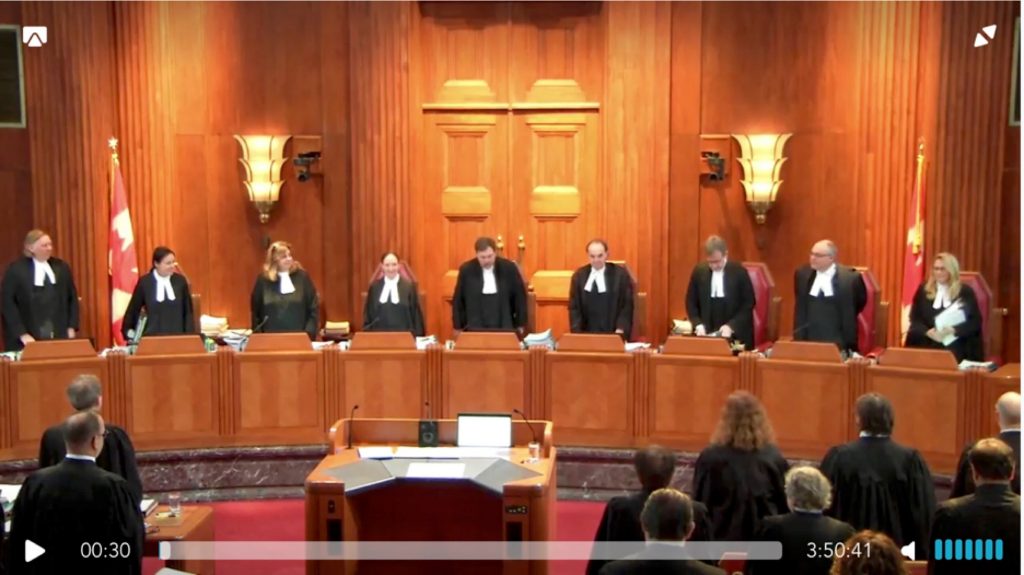
[Click on picture for link to archived webcast of SCC hearing on Dec 4, 2018]


Catherine Ma is a 3L JD Candidate at the Faculty of Law and was a student leader of the Asper Centre’s Indigenous Rights student working group in 2017-2018.  She was a summer law student at the Ministry for the Attorney General in 2018. 

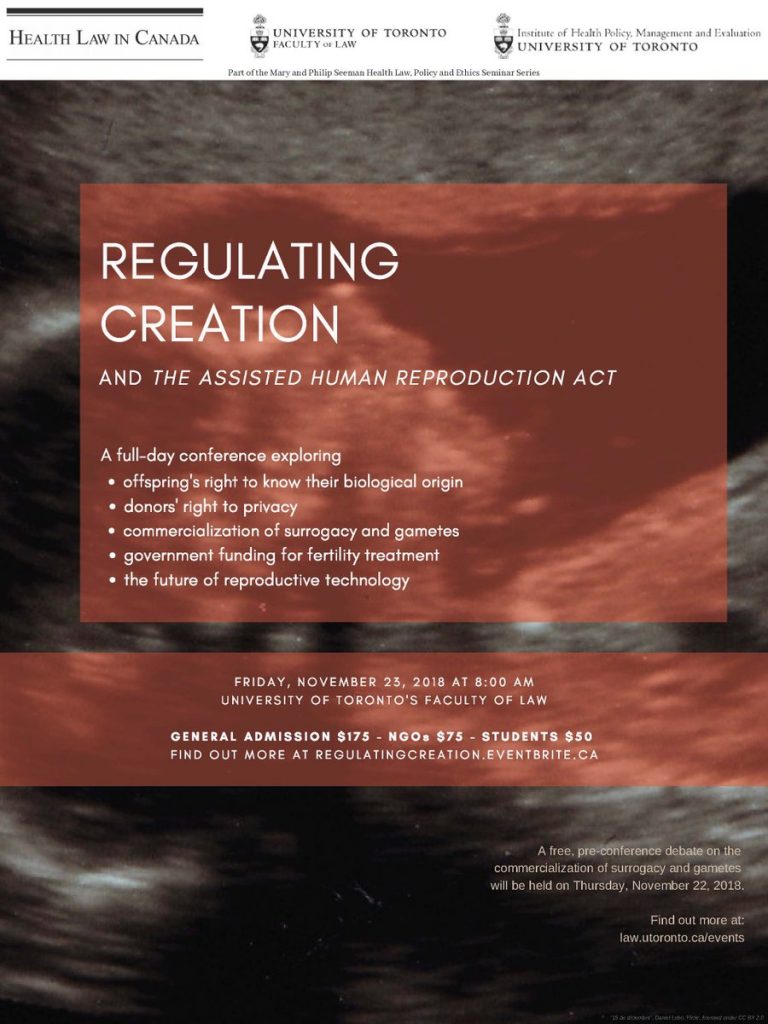
Asper Centre ED Cheryl Milne to take part in panel at upcoming Regulating Creation Conference

On Friday November 23, 2018, the Asper Centre’s Executive Director Cheryl Milne will take part in a panel about reconciling children’s rights and donors’ rights as part of a HEALTH LAW, POLICY AND ETHICS IN CANADA interdisciplinary conference titled “Regulating Creation and the Assisted Human Reproduction Act”, which will take place at the University of Toronto Faculty of Law.

Since the adoption of the Canadian Assisted Human Reproduction Act in 2004, assisted human reproduction has been developing at a very fast pace at a global scale, in a complex social, medical and industrial context. An early challenge of the legislation by Quebec in 2010 resulted in the removal of many key components of the legislation, particularly those related to the regulatory control and licensing of assisted human reproduction. New scientific developments, in particular those related to gene editing, have also inspired calls for changes to the remaining prohibitions. Both the federal government and the provinces are under pressure to re-imagine how assisted human reproduction should be regulated and funded in Canada. Since the Supreme Court’s decision, there have been new funding initiatives at the provincial level, and ongoing debate, yet limited action at the federal level with respect to the development of regulations about surrogacy and gamete donation. A recent proposal to repeal the Act’s prohibitions on payment for surrogacy and the purchase of gametes has renewed debate over the remaining criminal law-based restrictions. And while other countries have moved away from anonymous gamete donation, Canada’s legislation and case law continue to allow anonymity. Meanwhile, many investigative reports and scholarly research into assisted human reproductive practices, including surrogacy and gamete donation, have shed light on what is happening on the ground, and on the multitude of personal, economic, ethical and legal ramifications of Canada’s assisted human reproduction practice.

This one-day colloquium, preceded by an evening debate, will explore a number of key issues related to Assisted Human Reproduction.

Read the Regulating Creation – Agenda as of 12 Nov 2018 and to register for the Conference, please Click Here.