
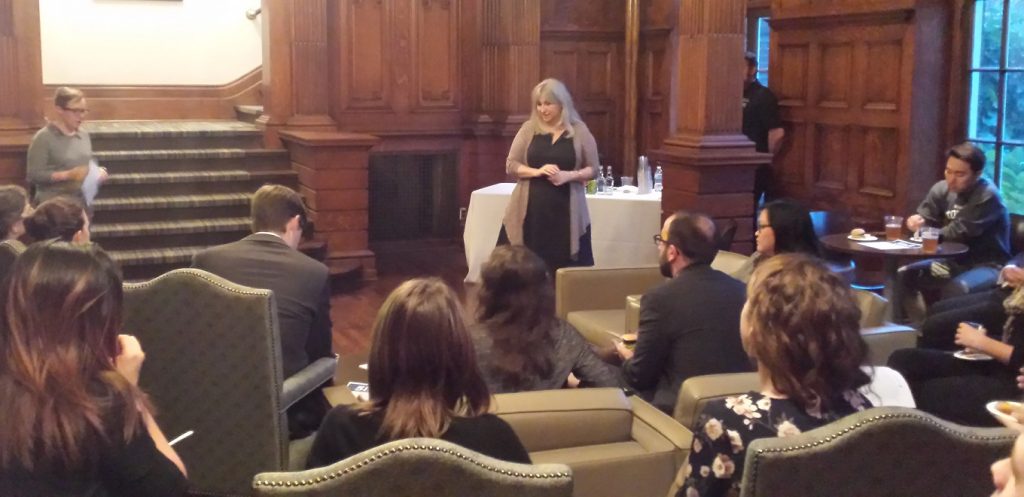
Asper Centre Alumni Network 5 in 5 Event

by Ryan Howes

On November 2, 2017, the Asper Centre hosted its inaugural Alumni Network event, a “5 in 5” panel in which five alumni each had five minutes to discuss an interesting advocacy case or initiative that they have worked on in their respective practices.  Breese Davies, the Asper Centre’s 2017 Constitutional Litigator-in-Residence moderated, introduced each speaker and kept time. The presentations highlighted the diverse and impactful work in constitutional litigation and advocacy that Asper Centre alumni engage in, often in collaboration with the Asper Centre.

An interesting theme that emerged from the discussions was the importance of narrative in legal advocacy. Facts are persuasive, but narratives are compelling. Narratives communicate the human dimension that exists behind the facts. Complimenting a strong body of supportive facts within a narrative that conveys the experiences of real people effected by the target issue supports effective advocacy.

Louis Century (JD/MGA ’13), an associate at Goldblatt Parners LLP, presented on being co-counsel for the Asper Centre as intervener in the Frank et al v Canada (Canadian non-resident voter) case at the Supreme Court of Canada (SCC). This case concerns the constitutionality of a law that bars expats from voting if they have been outside the country for 5 or more years. The law was upheld at the court of appeals. The appellate judge argued that, in order to qualify for voting, a citizen must have a stake in the society. Expats are therefore ineligible. There are no grounds for this in the constitution. Louis worked in collaboration with Asper Centre affiliate faculty to submit a factum, which addressed this “social contract” justification and promoted expats’ right to vote. The government has introduced a bill to amend this Act, so the SCC hearing was postponed to mid-2018. No legislative progress is yet evident.

Aria Laskin (JD ’14), an associate at Torys LLP, presented on her work with the Asper Centre and the University of Toronto Faculty of Law’s International Human Rights Program on behalf of detained children in Canada’s immigration facilities. Hundreds of immigrant children have been detained. A challenge that Aria faced in advocating for this cause was identifying different forms of advocacy beyond traditional litigation to work towards the ultimate goal: reducing and ending the immigration detention of children. In addition to litigation, Aria worked on public advocacy initiatives in order to raise awareness of the issue. This has had positive results. Fewer children are being detained today, and they are no longer being placed in solitary confinement.

Jennifer Luong (JD ’13), presented on her work at the Ministry of the Attorney General Constitutional Law Branch, where she acted as respondents’ counsel in the Grand et al v Ontario case. Jennifer represented the government in the challenge by families to the discriminatory consequences of the Children’s Law Reform Act. This Act identified a child’s parents as their natural parents, burdening non-traditional families with additional legal processes and costs in order to demonstrate parenthood over their child. The Grand case challenged the Act on these grounds. As a result, Ontario made remedial amendments to the Children’s Law Reform Act with the All Families Are Equal Act.

Marcus McCann (JD ’14), an associate at Symes Street & Millard LLP, presented on being co-counsel for an intervener in the upcoming Trinity Western University case at the SCC. He discussed the case in the context of two pertinent precedents, Loyola v Quebec and Doré v Barreau du Québec, arguing that the SCC’s decision in the Trinity Western University case will refine how these past rulings apply. For instance, Marcus predicted that the SCC’s decision might constrain Doré because in this instance there is a competing rights claim. Although the Trinity Western University case raises many interesting questions, Marcus argued that the SCC might limit the scope of its ruling and leave unaddressed such questions as whether corporations as legal persons are entitled to s. 2(a) rights.

Megan Savard (JD ’09), partner at Addario Law Group LLP, presented on her advocacy work surrounding criminal liability under the Assisted Human Reproduction Act, for which she has collaborated with Asper Centre clinic students in drafting submissions to government. The Act is vague in describing the criminal acts it identifies, which presents difficulties for persons working in assisted reproduction and surrogates. Megan’s presentation was a story of persistence and unexpected continuity following failure. She is currently in stage three of her legal advocacy, the first two stages having not resulted in the kind of government action she was advocating for. But she persists. Megan’s advocacy uses stories demonstrating the free agency of women who serve as surrogates to challenge policymakers’ fears that women will be exploited for purposes of reproduction. She also challenges arguments grounded in sanctity of the body.

In addition to Asper Centre alumni, some current Asper Centre clinic students and student working group members attended the event.  As a first year law student, it was both eye-opening and inspiring for me to see the relationship that former students maintain with the Asper Centre and that making such an impact is possible so soon after graduating from law school.

 Ryant Howes is the current work-study student at the Asper Centre and is also a first yer JD Candidate at the Faculty of Law. 


Asper Centre Public Interest Litigation Conference – Call for Papers

The David Asper Centre for Constitutional Rights is pleased to invite abstract submissions for its upcoming Public Interest Litigation Conference, which will be  held on March 2, 2018.  The Conference will be focused on legal strategies for successful public interest litigation in Canada, as a means to bring together relevant stakeholders to share their challenges, successes and strategies in this field.

Please find below the call for papers.  We invite proposals for papers in 2 formats: a longer paper covering pertinent issues related to public interest litigation in Canada and a shorter paper focused on lessons learned from a specific public interest case.  We hope that together these streams will generate positive response among both practitioners (lawyers and NGOs) who are engaged in public interest litigation and scholars who study and analyze the impact of these cases.

As indicated in the call for papers, please submit proposals to tal.schreier@utoronto.ca by November 30, 2017.

We look forward to receiving your applications and to hosting you in March!

Sincerely,
The David Asper Centre for Constitutional Rights

Public Interest Litigation Conference – CALL FOR PAPERS

Asper Centre to support efforts in challenging solitary confinement in Canada

by Tal Schreier

Long periods of solitary confinement can have a devastating impact on the mental and physical well-being of prisoners. Ending solitary confinement is not only morally just but also has practical benefits of improving public safety as prisoners who have been subject to solitary confinement often experience problems re-entering into society and have higher rates of recidivism. The current practice of solitary confinement in Canada risks violating the basic Charter rights of prisoners and according to international law, the use of prolonged periods of solitary confinement amounts to cruel and unusual punishment and even torture. Canada should fall in line with this international norm, and immediately curtail the practice of lengthy solitary confinement.

The Asper Centre has been observing two recent public interest litigation cases on this issue (both court decisions are still outstanding), the first of which was brought by the John Howard Society and the British Columbia Civil Liberties Association in the British Columbia Supreme Court, challenging the constitutionality of the current legislative provisions that govern the practice of solitary confinement. The other case was brought by the Canadian Civil Liberties Association and the Canadian Association of Elizabeth Fry Societies in the Ontario Superior Court of Justice, also a constitutional challenge to the practice of solitary confinement in federal penitentiaries in Canada.

Both cases are based on ss. 7, 12 and 15 of the Charter of Rights and Freedoms, in which the applicants attack various provisions of the Corrections and Conditional Release Act of 1992 which currently authorizes what is formally called “administrative segregation” indefinitely for a wide range of reasons. Although the Act stipulates that the practice is meant to be used as a last resort, it is ordered without independent or external oversight and is commonly extended for excessive periods of time.

Both these cases have proceeded to court despite the government having introduced in June of this year Bill C56, new legislation proposing a cap of 15 days on holding prisoners in solitary confinement (with an 18 month transition period after the bill passes into law during which time the cap will be set at 21 days). While Bill C56 is a welcome sign that government views the need to reform this harmful practice, the Bill contains a number of crucial flaws that will need to be addressed in order to bring the law properly into line with the Charter.

For example, the specific wording of Bill C56 allows the “institutional head” of a prison to extend administrative segregation past the capped period. The Bill also proposes “independent external review” which only comes into effect when the segregation continues beyond the capped period, however this review is on paper only. With no hearing or access to counsel, and an outcome of the review that is non-binding, this effectively means that the “institutional head” can disregard the recommendation and extend segregation. Furthermore, Bill C56 does not prohibit the practice of segregation for mentally ill persons or other vulnerable groups.

The Asper Centre clinic students are reviewing the proposed legislation and will be drafting submissions to Parliament on these and other identified issues with Bill C56.

Supreme Court’s Ruling in Recent Extradition Case Disappoints: Comment

by Patrick Enright

This past week the Supreme Court of Canada released its decision in the landmark extradition case of India v Badesha.  The case – which the Asper Centre intervened in earlier this year – involved the possible extradition of an infamous couple to India to face charges of conspiracy to commit murder.  The case raised the intriguing question of when, and if, diplomatic assurances from a foreign state can make extradition to a foreign state Charter-compliant. India, for its part, has a notorious human rights record with respect to treatment of prisoners in its custody. Systemic abuse, sexual assault, a lack of potable water, and cramped living conditions are all endemic throughout the system – and abuse from prison guards is a common occurrence.

The question before the Court was this: can mere assurances of safety from the Indian government make up for all this?

The Supreme Court’s answer seems to be “no.” But much remains uncertain. On the plus side, the Court made it clear that diplomatic assurances cannot, by themselves, make up for evidence of human rights abuses in a foreign country. And the Court made it equally clear that general evidence of widespread human rights abuses can be used as evidence that specific persons will be subject to torture and mistreatment upon extradition to a foreign state.

It also laid out the considerations that must be taken into account when assessing the reliability of assurances against torture. Factors such as the specificity of the assurances, the foreign state’s capacity to comply with the assurances, and the ability to monitor and verify the foreign state’s compliance with assurances must all be considered.

But the good news stops there. Much of the decision’s positive elements are muddled by the Court’s insistence on including a number of policy considerations that, we are told, must also colour the analysis. Courts must in each case consider the relationship between Canada and the recipient state, as well as the seriousness of the offence, when determining whether a surrender order meets constitutional muster.

There is, however, an obvious problem with this. The question of whether policy considerations should tip the scale in favor of extraditing leaves too much discretion in the hands of politicians – instead of the Courts. One only has to look at the fallout from the payment to Omar Khadr to realize that importing political considerations into questions of rights-protection is often a marriage made in hell.

When assessing the role of diplomatic assurances in determining whether extradition is appropriate, then, the question should be a simple one…can the state actually fulfill its promises?

The Asper Centre’s submissions urged the Supreme Court to place this question at the heart of the analysis on judicial review of extradition cases. We urged the Court to require the state to produce evidence that it could fulfill its promises and safeguard the rights of Canadian citizens’ subject to extradition. The court, for its part, only partially heeded our warning – opting instead to list a catalogue of things that are to be considered when assessing a surrender order – some rights-friendly, some not.

The Asper Centre’s outside counsel, John Norris, was also troubled by the court’s deference to the Canadian government on extradition cases, yet he too chose to see the silver lining as the court did in the end uphold the need to carefully consider human rights in extradition cases. “You can see it as the glass is half-full or half-empty. I prefer to see it as half-full because the emphasis on human rights is an important part of the judgment,” Norris commented.

As the proverbial wisdom has always said: sometimes you win, and sometimes you lose. And sometimes you lose, but the result isn’t quite as bad as you thought it might be.

And I guess that’s something.

Patrick Enright is a third-year JD candidate at the University of Toronto’s Faculty of Law and was a student in the Asper Centre half time clinic, who assisted with the Asper Centre’s intervention in this case.

A Preliminary Look at Bill C-59 and its Implications on Canadian Privacy Rights

By Natasha Anzik


The Liberals’ new national security legislation, Bill C-59, was tabled in the House of Commons on June 20th, 2017. The ten-part, 139-page legislation has taken a robust look at the current state of Canadian national security, proposing many changes and additions, but still leaves several gaps in the protection of Canadian privacy rights.

Last December the Asper Centre’s Privacy and National Security Working Group made a submission to the Department of Public Safety Canada and to the Department of Justice. This submission primarily dealt with the Charter implications of warrantless access to basic subscriber information, but also considered data retention and systems of review. Bill C-59 has also been criticized for its failure to address issues with regard to the Security of Canada Information Sharing Act, including its overbroad definition of security and the vast amount of information sharing permitted. While not discussed here, or as part of the Asper Centre’s submission, it is evidence of the breadth of issues that remain unresolved.

Basic Subscriber Information

The Asper Centre’s submission was made in response to Bill C-51 and the 2016 National Security Green Paper and called for several reformations to the accessibility of basic subscriber information (BSI) in order to be compliant with s. 8 of the Charter. BSI can simply be a name, address, telephone number, and matching an IP address. This seemingly unremarkable information, the working group argued, should be protected from warrantless access as the combination of this information can lead to inferences about an individual’s registered services, interests, organizational affiliations, and geographic location and therefore may engage one’s s. 8 Charter rights.

Issues were raised with respect to the Green Paper’s suggested lower evidentiary requirements for obtaining lawful access to BSI, and how this lower standard would run counter to the spirit of s. 8, which protects against unlawful searches. This argument was supported by the Supreme Court’s decision in R. v Spencer, which holds that subscriber information can carry a high expectation of privacy, and disclosure of this information is vulnerable to Charter challenges. As this decision was specific to Internet subscriber information, the working group recommended a consistent standard for the sharing, retention, and destruction of personal information across different platforms. Consistency across all law enforcement agencies would also help prevent backdoor information sharing. Another issue raised by the working group is that the metadata regime of the Criminal Code has historically been unclear, and interpreted to suggest that communications service providers can readily disclose subscriber information. The Asper Centre thus advocated for a federal law that clearly prohibits the voluntary disclosure of subscriber information by telecommunications companies, and requires judicial authorization for access.

The need for clarification of this area of law was echoed in the 2016 Green Paper. While the paper called for a clear law governing access to this information, Bill C-59 is notably silent on this issue. Although not considered now, its inclusion in the Green Paper suggests this issue will be addressed in future legislation, meanwhile this area of law will likely remain inconsistent and problematic for the privacy protection of Canadians.

While Bill C-59 does not address BSI specifically, the issue of access to information comes up in the regulation of the Communication Security Establishment’s (CSE) activities. The CSE is an intelligence network, focused on gathering information to protect Canada’s cyber security from external threats. The Bill provides for a large expansion of the powers of the CSE, but also provides several restrictions recognizing the potential for these expanded powers to engage the s.8 privacy rights of Canadians. One restriction includes limiting the CSE from directing their activities at Canada and people in Canada, but this does not prevent the agency from acquiring “publicly available information”, defined as information that can be made available upon request. Although the government argues that publicly available information would inherently have a lower expectation of privacy and therefore not engage s.8 of the Charter, this information could potentially include BSI that is voluntarily released by communication service provides. This allowance therefore could lead to privacy issues as described above. As the state of lawful access remains in flux, Canadians will remain vulnerable. These provisions will also be problematic in how they might inform the treatment of BSI in future legislation.

Systems of Review

One of the most prominent parts of the new Bill is its creation of the National Security and Intelligence Review Agency (NSIRA). The current system of review was an area of concern raised by the Asper Centre’s submission. The criticism focused on the limited powers of review allocated to the Privacy Commissioner and the review agencies for CSIS, the RCMP, and the CSE. This system not only creates a silo effect between agencies, but also demands increased resources and understanding to sufficiently oversee the mass of information in and between national security agencies. Bill C-59 addresses this issue and the need for increased accountability and public confidence in its creation of the NSIRA. Outlined in the Bill’s Charter Statement, the job of the NSIRA would be to “review and report in an integrated manner on the lawfulness of all national security and intelligence activities across government, thereby enhancing accountability, transparency and the safeguarding of human rights in Canada.” Part 2 of the Bill would also establish a quasi-judicial Intelligence Commissioner, who would review certain decisions regarding intelligence gathering. These new review systems seem promising in their ability to rectify the lack of broad oversight, to increase accountability, and to correct the current silo effect.

Data Retention

The Asper Centre’s submission also encouraged the establishment of a scheme of data retention that maintains a balance between Canada’s national security interests and privacy protections. The Asper Centre discouraged mandatory minimum retention schemes and unlimited information sharing between agencies, and argued that these data retention schemes should have a system of independent review for the use of information once obtained. Bill C-59 does not address this issue at length, but does allow the limited retention of datasets, which require judicial authorization that is valid for no more than two years. Dataset use must also be “strictly necessary”, and will be subject to review by the Intelligence Commissioner. While this change does not fully address all the concerns of the Asper Centre, it is a step forward in the establishment of a more robust scheme of information storage that hopefully will be refined to ensure further Charter compliance.


While this Bill has made strides with respect to the Asper Centre’s concerns, there are still some gaping holes with respect to the privacy protections afforded to Canadians. It seems unlikely that lawful access to basic subscriber information will be addressed in the passing of Bill C-59, as this was an issue at the attention of legislators as part of the Green Paper consultation process, but was actively excluded in the drafting of the Bill. Hopefully the review process of the Bill will lead to further clarification of the powers of the CSE in collecting information, how basic subscriber information relates to “publicly available information,” and may engage s. 8 of the Charter. These issues will have the potential to be raised to the Standing Committee on Public Safety and National Security this fall.

Natasha Anzik is the Asper Centre’s summer research assistant and an upcoming 2L JD Candidate at the Faculty of Law.