
The Hon. George Strathy, Chief Justice of Ontario delivered the Morris A. Gross Memorial Lecture hosted by the Asper Centre on January 19th, 2017


By Peter Boisseau / Photography by Oliver Salathiel

Judges should demonstrate “humility and humanity” when dealing with court cases involving Indigenous peoples, Ontario Chief Justice George Strathy, told a Faculty of Law audience at the Morris A. Gross Memorial Lecture.

Speaking in the context of Canada’s ongoing reconciliation movement with its Indigenous population, Strathy said the wounds the residential school system inflicted on individuals and their families have to be taken into account by the courts.

“I think both as a judiciary and a society, we have to have the humility to recognize what we’ve done wrong, and confront the issue, and recognize other people’s experiences and what they went through, and to engage in a respectful dialogue about how we can address the injustices of the past,” Strathy said at the Jan. 19th lecture.

Embracing the “Gladue spirit” in criminal sentencing is part of that reconciliation, said Strathy, referring to a principle arising from a 1999 Supreme Court of Canada decision directing judges to consider non-custodial sentences as a way of recognizing the racism and discrimination faced by Indigenous peoples.

“Society changes, law changes, institutions change. The law has to evolve, and the Constitution, and our interpretation of the Constitution, has to evolve.” — Chief Justice Strathy

“We have to look into the Indigenous experiences of the individual going back many generations, and to what brought the person before the court,” he said.

“And I think, if in our relationship with Indigenous peoples, we can bring a Gladue spirit to the approach, a spirit that recognizes how we got to where we are today, that would be a good start.”

students listening the Strathy lecture

Strathy said that approach ties into the virtues of humility and humanity which are important for every judge to have.

The movement to rebuild relationships between Indigenous populations and the rest of Canadian society has been driven in large part by a 2015 report of The Truth and Reconciliation Commission documenting the scope and impact of residential school system abuses on generations of First Nations, Inuit and Métis children.

Under the system, approximately 150,000 Indigenous children were forcibly taken from their families and placed in residential schools across Canada. Most suffered physical, emotional, and sexual abuse. The last of those schools closed in 1996.

Many say the impact of that systemic racism and discrimination is illustrated in the disproportionate number of prison inmates who are Indigenous. While Indigenous peoples make up about four per cent of the Canadian population, they comprise almost 25 per cent of federal prison inmates.

Strathy’s remarks came in response to a question by Cheryl Milne, executive director of the David Asper Centre for Constitutional Rights, which is sponsoring a series of lectures on Canadian constitutional law and human rights to mark the 150th anniversary of Confederation this year.

A U of T law school alumnus who was appointed chief justice in 2014, Strathy said one of the greatest challenges for the judiciary has always been balancing the virtues of courage with restraint, so they know when to act, and when to stop from going too far.

“Excess of courage can lead to arrogance in thinking that we judges know better than the legislature in matters of policy, whereas excess of restraint can lead to timidity in the face of abuses of state power.”

Strathy cited several landmark decisions handed down by former Supreme Court of Canada Justice Ivan Rand, a celebrated jurist whose biographer says held deeply bigoted views about French Canadians and Jehovah’s Witnesses, among others.

Yet in the 1950s, Rand struck down a Quebec City municipal bylaw restricting the rights of Jehovah’s Witnesses to distribute religious materials, and also wrote a decision against the provincial government’s attempt to close buildings used by communists.

“According to his biographer, Rand had some personal views all of us would find repugnant,” said Strathy. “Yet when I read his judgements, he seemed able to neutralize his personal views.”
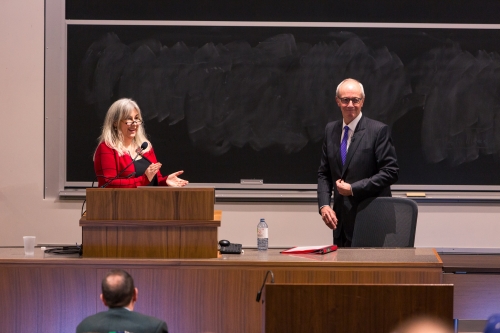
Cheryl Milne thanks Chief Justice Strathy

Asper Centre Executive Director thanks Ontario Chief Justice George Strathy after his lecture.


The ability of judges to set aside prejudices and guard against their own beliefs from colouring their decisions has become even more important since the enactment of the Charter of Rights and Freedoms as part of the Constitution Act of 1982, he added.

While pre-Charter judgements sometimes impacted civil rights “incidentally” as a matter of common law, the modern constitution gives courts the express responsibility to strike down laws they determine violate the Charter.

“Interpreting Charter rights goes well beyond common law civil liberties. I think life was much easier for judges in the pre-Charter era. The Charter was a game changer.”

Sometimes the courageous thing to do is resist public pressure and political consequences, said Strathy.

In a famous ruling made by former SCC Justice Peter Cory—for whom Strathy worked while attending U of T when Cory was in private practice—he threw out a case against four accused, ruling their Charter rights had been violated because they had been forced to wait almost two years before going to trial.

Thousands of charges in other cases were subsequently dismissed or withdrawn in the early 1990s as a result of Cory’s ruling.

When considering Charter issues, Strathy said he thinks judges are best served by restricting their deliberations to the narrowest scope of the law regarding the case in front of them.

“The Charter expects more of judges, and in return it gives them unprecedented authority with respect to legislation,” said Strathy.

“But the abuse of judicial power is just as bad as the abuse of any other power, perhaps worse, because elected politicians can be voted out of office.”

By the same token, deferring too much to politicians and legislatures can be a vice if it leads to the infringement of rights and freedoms.

During his lecture, Strathy referenced a case he was involved in around the time he was appointed chief justice, not as an example of courage or restraint, but simply to explain his own “evolution as a judge.”

Sitting on a three-member panel, he wrote a judgement striking down a portion of The Truth in Sentencing Act on the grounds it violated the Charter, essentially dealing a blow to the Conservative government that had just appointed him.

In response to a question by the Faculty of Law’s Dean Ed Iacobucci, Strathy says the 30 judges in his court do not worry about whether their cases will be appealed to the SCC, nor do they give any influence to the “notwithstanding clause,” which gives Parliament and provincial legislatures the authority to override portions of the Charter.

Answering a question by Toronto lawyer and U of T law school alumnus Gavin Magrath, Strathy made it clear that he feels judges have to be able to change with the times.

“Society changes, law changes, institutions change. The law has to evolve, and the Constitution, and our interpretation of the Constitution, has to evolve.”

Asper Centre’s fireside chat delves into the future of Charter litigation in Canada

Asper Centre Fireside Chat with David Asper and Raj Anand

Should a government pay for its citizens to challenge the constitutionality of that government’s laws?  How reliable is a government’s commitment to provide this kind of funding?  More generally, is constitutional litigation the best way to protect Canadians’ constitutional rights?

On a cold November evening, the David Asper Centre for Constitutional Rights convened a fireside discussion of these questions in the Jackman Law Building.  The discussion featured alumni Raj Anand, LLB 1978, a prominent constitutional litigator and bencher of the Law Society of Upper Canada, and David Asper, LLM 2007, the Centre’s founder and a successful criminal/constitutional litigator.  (Most notably, Asper represented David Milgaard in overturning Milgaard’s wrongful conviction.)

Cheryl Milne, executive director of the Asper Centre, chaired the discussion, the focus of which was the Court Challenges Program (“CCP”).  Created in 1978, the CCP funded legal challenges to laws offending equality and official language minority rights guaranteed under the Canadian constitution, including the Charter of Rights and Freedom.  The program has funded more than 1,200 cases, but has also been cancelled, twice, by governments averse to funding challenges to their own laws.  The current Liberal government plans to revive the CCP, and is undertaking consultations to this end.

The discussion was a study in contrasting viewpoints: Anand’s more conservative (reflecting his long experience as a member of the CCP’s Equality Rights Panel), and Asper’s more radical.  Asper was adamant, for example, that the CCP’s strength comes from its independence.  “It’s irresistible, in my view, that when you have an organization whose objective is to challenge the government, sooner or later the government will defund you—whatever the stripe.”  Anand replied that perfect independence is impossible: “Ultimately, public money has to be carefully safeguarded and spent pursuant to government policies. So, like it or not, there are always public servants that have a direct and indirect impact on the program.”

Asper was unmoved, suggesting at one point that the CCP will always be “a sitting duck for government.”

While both lamented the CCP’s suspension by the Conservative government in 2006, they fastened upon different effects as being most significant.  Anand noted the deleterious effect on s. 15 of the Charter (equality rights) jurisprudence because of fewer, and more poorly supported, cases being brought to trial.  (“The kinds of arguments that were brought… became very weak.”)  Asper characterized the CCP’s suspension as anti-constitutional: “It sent a signal to Canadians that we were somehow less willing to get into the risk of rights litigation.  It was totally contrary to the spirit of the Charter.”

Milne then asked whether, given the CCP’s inherent limitations (in addition to independence issues, the CCP’s funding mandate—limited to equality and official language minority rights cases—has long been criticized as far too narrow), the CCP was the best way to support Charter litigation in Canada.

Asper dismissed this as a red herring.  “Something is better than nothing,” he said, “but the discussion of CCP is a Band-Aid to a much more significant problem in the Canadian justice system.”  Specifically addressing those in the audience watching live via webcast from Ottawa, he continued, “I believe that the courts, and the things that radiate inward from courts—judges, lawyers, systems, processes— are failing us.  The court system itself is the biggest barrier to the adjudication of Charter rights.”

Anand was much more circumspect.  “I think it’s a bit of a distraction to say that we have a bigger problem [i.e., access to justice] and therefore we shouldn’t look at this little problem [the CCP] and try to fix it.  We have a rare opportunity here, and the question should be how we put this program back in place more durably and more effectively than the previous program.”

The ensuing discussion canvassed various alternatives to constitutional litigation, including less reliance on traditional adversarial processes (at the cost of establishing fewer binding precedents), a specialized constitutional court (diametrically opposed to the Supreme Court of Canada’s view on which tribunals can adjudicate Charter claims), and reformed civil procedure rules.  Several members of the audience wondered at the viability of privately funded litigation supplanting the CCP, such as US-style charitable organizations seeking public interest standing to bring constitutional challenges.

No consensus emerged, and the discussion concluded with Asper underlining the ongoing—soon to be imminent—need to re-engage Canadians on the importance of Charter litigation following the CCP’s suspension in 2006: “We’ve probably come through an era of government where [the Charter] wasn’t so popular,” he said, “and that’s no longer the case.”  Asper concluded by reminding the audience of what he sees as the broader context for the reformed CCP.  Once again addressing the audience watching by webcast, he said, “Canadians are losing faith in our justice system as we continue to talk about doing all these things to fix it, and don’t fix it.”

By Christopher R. Graham / Photography by Salathiel Wesser

Asper Centre discusses Legal Professionalism and Ethics with Law Students

It is well-known that lawyers are bound to the highest of ethical standards arising from the Law Society’s rules of professional conduct and ethics.  While law students are officially not bound by the same rules, the standards of professionalism and ethics arguably apply to students who are in essence at the very beginning of their legal careers.

In light of the above, first year students at the University of Toronto Faculty of Law must attend mandatory Professionalism and Ethics classes, with some of the curriculum emanating directly from the Law Society of Upper Canada. Furthermore, the Faculty offers a number of elective courses that examine the complex issues entailed within the broad topic of lawyers’ professional ethics.  An example of such a course is this Fall term’s upper year elective taught by visiting professor Allan Hutchinson, a well-known legal theorist from Osgoode Hall Law School, with an international reputation for his original and provocative writings on the legal profession. This intensive course, entitled Legal Ethics and Lawyer Regulation, focused on legal ethics and the regulation of the legal profession and it examined various topics such as the lawyer-client relationship, confidentiality, conflicts of interest, the duty of loyalty and ethics in advocacy, counseling and negotiations.

On November 9, 2016, the Asper Centre’s Executive Director Cheryl Milne and the Centre’s Constitutional Litigator in Residence Janet Minor participated in a panel discussion in Professor Hutchinson’s course, in order to highlight to the students some of the ethical and professionalism issues that arise in their specific law practices.  Ms. Renatta Austin (JD 2014), a lawyer in private practice, also took part in the panel discussion.

Ms. Austin began the session by talking about the issue of lawyer competence as it relates to professionalism.  In her sole-practice, she explained how she is sometimes wary of overextending herself by taking on legal matters for which she does not have the requisite experience.  She also cautioned against taking on more than one type of matter for a client, providing an example of a lawyer she interacted with whom she observed representing both parents in a child wardship case while also representing one of the parents in a criminal matter.  She criticized this practice as cases often have different goals and paramount interests and thus taking on all of them can potentially create ethical issues.

Ms. Minor provided the class with a perspective of some of the ethical issues encountered by a government lawyer.  She spent the bulk of her lengthy legal career as General Counsel in the Constitutional Law Branch of the Ontario Ministry of the Attorney General. She discussed ethical responsibility, the role of the Attorney General and the challenges of being a government lawyer, in particular the conflict that may arise when government lawyers must defend policy or legislation that may clash with their personal opinions.  In response to a question, Ms. Minor surmised that government lawyers, while held to the same ethical and professional standards as other lawyers, are often viewed by judges differently and held to an even higher standard as they are expected to demonstrate the best conduct, provide total disclosure, always act with courtesy and not exhibit any ‘shark-like’ lawyer practices.

Ms. Milne started her presentation by discussing the various ethical issues she encountered while working as staff lawyer at the NGO Justice for Children and Youth, such as having to diligently ensure that her child clients were deemed competent to provide her with instructions. She then highlighted her unique dilemma as the Executive Director of the Asper Centre charged with promoting the work of the Centre, while at the same time acting as the lawyer of record on many of the Centre’s cases, thereby being bound by the duty of confidentiality insofar as publicly discussing the cases.  This dual role perhaps may seem confusing to students but Ms. Milne treads carefully in both roles and ensures her clients’ interests at all times.

The number and quality of questions and comments exchanged between the students and the presenters during this panel discussion demonstrated that law students are indeed engaging with these issues in a meaningful way, thus preparing to assume the professional and ethical obligations that they will ultimately owe themselves, the public and their profession.


Asper Centre was granted leave to intervene in the SCC case on voting rights for long-term expats

The case, Gillian Frank, et al. v Attorney General of Canada concerns two applicants who are Canadian citizens residing in the United States for employment reasons, who intend to return to Canada if circumstances permit. Both applicants were refused voting ballots for the 2011 Canadian General Election since they had been resident outside Canada for five years or more. The applicants sought a declaration that certain provisions of the Canada Elections Act violated their Charter-protected right to vote. A judge of the Ontario Superior Court of Justice declared the impugned provisions of the Act unconstitutional by reason of violating the applicants’ right to vote under s. 3 of the Charter, and the violation was not justifiable under s. 1.

A majority of the Court of Appeal allowed the Attorney General’s appeal, finding that the denial of the vote to non-resident citizens who have been outside Canada for five years or more is saved by s. 1. The limitation is rationally connected to the government’s pressing and substantial objective of preserving Canada’s “social contract” (whereby resident citizens submit to the laws passed by elected representatives because they had a voice in making such laws); it minimally impairs the voting rights of non-resident citizens by ensuring they may still vote if they resume residence in Canada; and the limitation’s deleterious effects do not outweigh the law’s benefits. In dissent, Laskin J.A. would have dismissed the appeal, finding that the “social contract” was not an appropriate nor a pressing and substantial legislative objective, and should not have been considered by the court. Justice Laskin also found that the denial of the right to vote was not rationally connected to the stated objective and did not minimally impair the rights of non-resident citizens, and that its harmful effects outweighed the stated benefits of the limitation.

The Asper Centre will intervene in March of 2018.