
Homelessness Recognized as an Analogous Ground Under Section 15: Waterloo v Respondents

By Avreet Jagdev  

On May 21, 2026, Justice Gibson of the Ontario Superior Court of Justice released his landmark decision in The Regional Municipality of Waterloo v Named Respondents and Persons Unknown (“Waterloo v Respondents“), in which he recognized homelessness as an analogous ground of discrimination under Section 15(1) of the Charter.  

Section 15(1) and Homelessness  

S.15(1) enshrines the right to equality in Canada’s Constitution. It states that: “Every individual is equal before and under the law and has the right to the equal protection and equal benefit of the law without discrimination and, in particular, without discrimination based on race, national or ethnic origin, colour, religion, sex, age or mental or physical disability.”

Importantly, the grounds of distinction enumerated in s. 15 are not exhaustive or closed. Courts have the jurisdiction to recognize additional grounds of discrimination that are analogous to those listed in the provision. An analogous ground must be a personal characteristic that cannot be changed, or that can only be changed at an unacceptable cost to personal identity. Over years of s. 15 jurisprudence, the Supreme Court of Canada has recognized non-citizenshipsexual orientation, and marital status as analogous grounds of discrimination, among others 

While the Supreme Court has no express guidance on the point, lower courts have previously found that homelessness is not an analogous ground. In the 2013 case Tanudjaja v Canada (“Tanudjaja”), the Ontario Superior Court of Justice held that homelessness and “being without adequate housing” do not form analogous grounds of discrimination under s. 15 (para. 137). The court found that a lack of adequate housing is neither a personal characteristic nor a fact that can be objectively determined, making it difficult to define the parameters of the analogous group. In coming to this conclusion, Justice Lederer stated the shared characteristic between the applicants, who were several individuals who had experienced homelessness and inadequate housing, was poverty. However, lower courts have found that poverty is not a recognized analogous ground under s. 15. Since the claim in Tanudjaja was struck at a preliminary stage and later resolved on justiciability grounds on appeal, the question of whether homelessness constitutes an analogous ground was never fully decided.  

Case Background 

In Waterloo v Named RespondentsJustice Gibson took s. 15 a significant step forward by recognizing homelessness as an analogous ground of discrimination. The case concerned an encampment located on a private parking lot owned by the Regional Municipality of Waterloo (“Waterloo”), which has been a sheltering space for homeless persons since 2021.  

In 2023, Waterloo applied to the Superior Court of Justice for permission to clear the site. The court declined this request because it determined that it would unjustifiably deprive the encampment residents of their Section 7 Charter rights. Since the release of that decision, homelessness has more than doubled in Waterloo, while the shelter system has capacity to accommodate only 15% of the homeless population. 

Two years later, Waterloo returned to the court in Waterloo v Named Respondents. This time, it sought to clear the site for construction of a major transit hub project, which it described as vital to its economic and social growth. Waterloo maintained that the encampment site was the only land it owned that could accommodate the project, with no existing alternative. Accordingly, it passed By-law Number 25-021, which states its intention to obtain vacant possession of the encampment site, and authorizes it to take steps to vacate and restrict access to the site. Waterloo subsequently applied to the court seeking, among other forms of relief, a declaration that their by-law complies with the Charter. The respondents, who are homeless people who shelter at the encampment, initiated a cross-application seeking a declaration that the by-law violates their ss. 7 and 15(1) Charter rights. 

Among the eleven issues before the court was whether homelessness constitutes an analogous ground under s. 15. Justice Gibson, in dismissing Waterloo’s application and granting the respondent’s cross-application in part, declared that the by-law violated their ss. 7 and 15(1) rights in a way that could not be justified by s.1 of the Charter.  

Justice Gibson’s Reasoning  

In conducting the first step of the s. 15(1) test, which requires identifying a distinction based on an enumerated or analogous ground, Justice Gibson held that “the time has come that homelessness be recognized as an analogous ground for the purposes of s. 15 of the Charter” (para. 204). In coming to this conclusion, he drew support from Chief Justice Wagner’s concurring reasons in Quebec (Attorney General) v. Kanyinda, a recent s. 15 decision in which the Supreme Court of Canada found that the exclusion of refugee claimants from eligibility for subsidized daycare infringed their s. 15 right to equality, because it discriminated against women refugee claimants.  

In his concurring remarks, Chief Justice Wagner described indicators developed by the Supreme Court that can be used to identify an analogous ground. These indicators include “the violation of human dignity and freedom resulting from a distinction based on a stereotype”, historical disadvantage suffered by a group, a group’s “vulnerability and marginalization”, the “‘immutable’ nature of an individual’s personal characteristics”, and “recognition by legislators and jurists that a ground is discriminatory”.  

Justice Gibson held that homelessness shares many of these attributes: First, distinctions based on homelessness violate the dignity of those with homeless status. Second, Justice Gibson held that homelessness is a constructively immutable characteristic because it is not within an individual’s control and cannot be readily altered by conscious action due to the many factors that may result in a person becoming homeless. Third, the homeless are a historically disadvantaged group. Fourth, the homeless are a vulnerable and marginalized group in society. Fifth, international instruments and organizations support the recognition of homeless status as an analogous ground.  

On this basis, Justice Gibson concluded that the first step of the s. 15(1) test was satisfied, as Waterloo’s by-law created a distinction on the basis of homeless status. Justice Gibson held that the second step, which asks whether the distinction has the effect of reinforcing, perpetuating, or exacerbating a claimant’s disadvantage, was also satisfied because Waterloo’s distinction denied a benefit in a discriminatory manner. 

Justice Gibson further held that the by-law resulted in a disproportionate impact on homeless individuals who are women, disabled, and Indigenous, all recognized grounds under s. 15. With a s. 15 infringement established, Justice Gibson found that Waterloo’s By-Law could not be justified under Section 1 of the Charter because it was not minimally impairing, and its deleterious effects outweighed any salutary ones. Therefore, Justice Gibson concluded that the by-law was unconstitutional, and therefore of no force or effect. 

To fulfill its Charter obligations, Justice Gibson explained that Waterloo would need to include an alternative encampment site or tenting protocol that would facilitate access to the current level of services and healthcare the encampment has. He welcomed Waterloo to return before the court once it promulgated these options to request a review or further discretion. 

Looking Forward  

This case has received significant acclaim and has been described by housing advocates as “one of the most important court decisions on homelessness in recent Canadian history”. However, it has also faced backlash, with Ontario Premier Doug Ford supporting Waterloo’s decision to appeal the decision 

It remains to be seen whether the appeal will succeed. For the encampment residents, the decision means that they will be able to stay put for the time being. But in the words of Justice Gibson, “No one should romanticize or be starry-eyed about the Encampment. It is a miserable and desperate place. But it represents the only remaining safety valve for the Region’s homeless as a refuge of last resort” (para. 249). 

Avreet Jagdev is a rising 2L JD Candidate and Summer RA at the Asper Centre. 
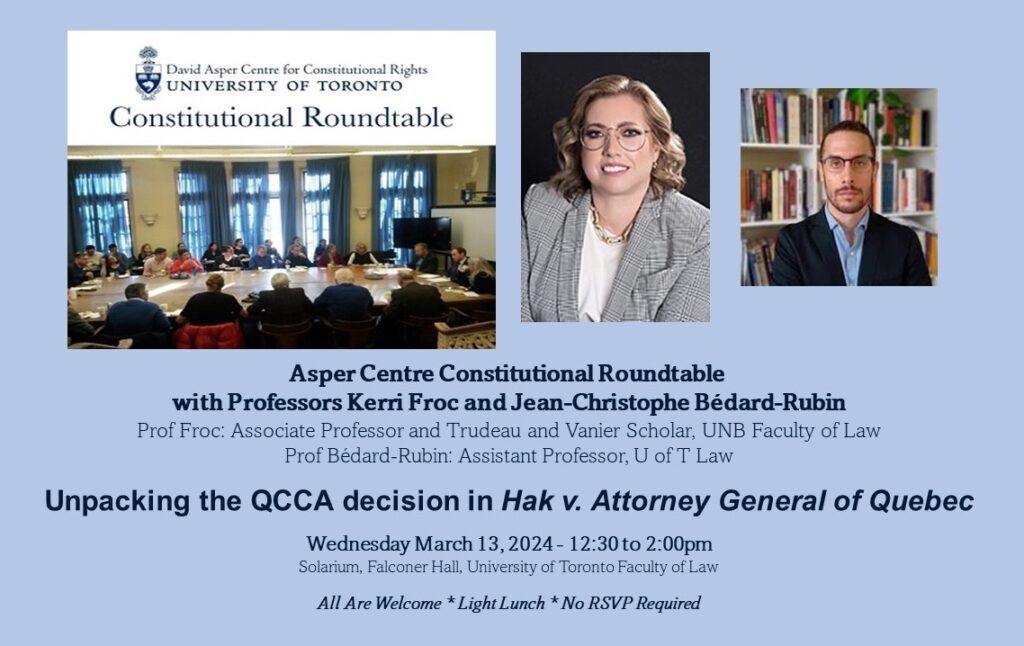
Constitutional Roundtable with Professors Kerri Froc and Jean-Christophe Bédard-Rubin on the QCCA decision in Hak v. Attorney General of Quebec

The Asper Centre Constitutional Roundtables are an annual series of lunchtime discussion forums that provide an opportunity to consider developments in Canadian constitutional theory and practice. The series promotes scholarship and aims to make a meaningful contribution to intellectual discourse about Canadian and comparative constitutional law.

We are pleased to host Associate Professor Kerri Froc (UNB Law) in conjunction with Assistant Professor Jean-Christophe Bédard-Rubin (U of T Law) for a Constitutional Roundtable on March 13, 2024 in the Solarium, Falconer Hall, Faculty of Law.

Professors Froc and Bédard-Rubin will break down the Quebec Court of Appeal’s decision in Hak et al. c. Procureur général du Québec, concerning the constitutionality of Bill 21, An Act Respecting the Laicity of the State. This appeal concerns freedom of expression, freedom of religion and equality rights, as Muslim women in Quebec who wear religious symbols such as the niqab or hijab would be prohibited from working in certain professions and in most parts of public administration, and prevented from benefitting from some public services because the law requires them to do so with their faces uncovered. The government of Quebec also pre-emptively used the override clause to prevent any constitutional challenges to the legislation. This Constitutional Roundtable will cover what this decision means for Charter rights, gender equality, and state use of the “notwithstanding clause.”

Kerri Froc is an Associate Professor at UNB Law, as well as a Trudeau and Vanier Scholar. She has taught courses at Carleton University, Queen’s University and University of Ottawa on feminist legal theory and various aspects of public law, among others.

Kerri received her PhD from Queen’s University in 2016 and holds a Master of Laws from the University of Ottawa, a Bachelor of Laws from Osgoode Hall Law School and a Bachelor of Arts from the University of Regina.

Before completing her doctorate, she spent 18 years as a lawyer, as a civil litigator in Regina, a staff lawyer for the Women’s Legal Education and Action Fund (LEAF), and as a staff lawyer in the areas of law reform and equality at the Canadian Bar Association. She is a member of the Saskatchewan and New Brunswick bars.

Assistant Professor Jean-Christophe Bédard-Rubin’s work explores Canadian constitutional culture from historical and comparative perspectives. He studied law, political science, and philosophy at Université Laval, Yale University, and the University of Toronto. During his doctoral studies, Jean-Christophe was the McMurty Fellow of the Osgoode Society for Canadian Legal History and a Joseph-Armand Bombardier Scholar. He has done consultancy work on constitution-building for International IDEA and, prior to his graduate studies, he worked in litigation for the Quebec Department of Justice.

Bédard-Rubin currently pursues two main research projects. The first is an intellectual history of the foundations of public law in French Canada. This project seeks to reconstruct the intellectual networks in which French Canadian public lawyers participated to excavate the transatlantic influences on the formation of Quebec’s legal syncretism. This genealogical reconstruction recovers the conceptual and theoretical innovations that allowed French Canadians to articulate a genuine theory of the state outside of the revolutionary framework. In so doing, this work sheds a different, somewhat oblique light on Canada’s constitutional experience and questions its status in comparative constitutional scholarship.

The second research project investigates judicial bilingualism in Canada. Using mixed social science methods, this project explores the various empirical impacts of bilingualism on judicial behaviour, the normative significance of legal bilingualism for the authority of judicial decisions, and the ways in which language shapes the dominant conception of the judicial role in Canada’s French and English public spheres.

Jean-Christophe’s work has been published in English and French in the Review of Constitutional Studies, the Canadian Journal of Law & Society, the Osgoode Hall Law Journal, the Bulletin d’histoire politique, and the International Journal of Canadian Studies, amongst others.

All are welcome * Light lunch provided * No registration required

Litigating Equality in Canada Symposium

In the past decade, several decisions from the Supreme Court of Canada have articulated a revised understanding of the way that section 15 of the Charter is to be applied in Charter litigation. In particular, Fraser has been interpreted by some as modifying the approach by claimants in establishing a section 15 breach and placing more focus on the government’s burden of justification. Most recently, Sharma has articulated an evidentiary burden as part of the test. The Courts have also been challenged to examine the implication of equality rights in Charter challenges and sentencing cases in the criminal law context in ways that place a heavy focus on racial inequities. The events of the summer of 2020 and the Black Lives Matter movement have highlighted the importance of cases such as R v Sharma and R v Morris, that have recently been considered by our courts. The Supreme Court of Canada has also shown an increasing interest in scholarship in the analysis of the law, while at the same time, we are seeing an increased interest and influence of interveners in these cases.

In light of the above developments, the Asper Centre convened a one-day Symposium (in-person and via Webinar) on Friday May 26th, 2023, to critically examine the status and future of equality litigation in Canada. The Symposium was aimed at both practitioners (lawyers and NGOs) who are engaged in public interest litigation and scholars and students who study and analyze the impact of these cases.

Some of the themes that were covered in the Symposium include an analysis of the recent Supreme Court rulings under s.15 of the Charter and their impact on litigation strategies on behalf equality seeking groups and the government; whether and how interveners have made an impact on these cases; the nature of the evidence required to successfully argue or defend these cases; and, lessons from successful as well as unsuccessful litigation in this area extracted from individual cases.

This Symposium builds on some of the themes explored in the Asper Centre’s 2018 Public interest Litigation Conference (and the publication following that Conference) in order to contribute to the practical scholarship on equality litigation in Canada and to produce a follow-up publication to this earlier work.

The Symposium included a morning plenary session on the role of interveners in equality litigation in Canada, a closing panel offering reflections and perspectives from the bench, as well as a full day of panel discussions by academics and practitioners focusing on the above-noted issues.

Link to the BOOK published following the Symposium

View Symposium AGENDA with Speakers Bios and Abstracts

View archived webcast of the Symposium

The SCC in R v J.J.: Upholding the Constitutionality of Criminal Code Reforms which Remove Barriers that Deter Sexual Assault Complainants from Reporting

By: Caitlin Salvino

On June 23rd, 2022 the Supreme Court of Canada (SCC) released its decision in R v J.J..[1] This 6–3 ruling upheld the constitutionality of recent amendments to the Criminal Code that remove barriers for complainants within the sexual assault trial processes. This piece provides an overview of the history of sexual assault provisions in the Criminal Code and the SCC’s decision in J.J..

History of Sexual Assault Criminal Code Provisions

In 1983, the Criminal Code was reformed to narrow the provisions of “rape” and “indecent assault” into three levels of sexual assault.[2] The 1983 reforms also removed exemptions for marital rape and prohibited evidence on the complainant’s sexual history, subject to  limited exceptions.[3] Following the 1983 Criminal Code reforms, the constitutionality of limits on complainant sexual history evidence was challenged in R v Seaboyer.[4] In Seaboyer, the SCC struck down the Criminal Code provisions related to sexual history, finding that they excluded relevant evidence that would interfere with the accused’s right to make a full answer and defence.[5] The SCC held that these provisions were overbroad as they did not minimally impair the accused’s procedural rights.

In response to Seaboyer, Parliament re-introduced Criminal Code provisions that limited complainant sexual history evidence. These reformed sexual history provisions were deemed constitutional by the SCC in R v Darrach[6] and remain in place today under section 276 of the Criminal Code. These section 276 protections, also known as the “rape shield law”, establish that evidence related to the complainant’s sexual history is inadmissible if it supports assumptions that the complainant is: (1) more likely to have consented to the sexual activity at issue during the trial or (2) less worthy of belief.[7] Section 276 creates an exception to the prohibition of evidence related to sexual history, that requires four criteria to be met: (1) the evidence is not being introduced for the above mentioned assumptions (consent and belief), (2) the evidence is relevant to an issue at trial, (3) the evidence is of specific instances of sexual activity, and (4) the evidence has significant probative value that is not “substantially outweighed by the danger of prejudice to the proper administration of justice”.[8] Section 276(3) lists numerous considerations that judges must take into account during a sexual history evidence admissibility hearing, including society’s interest in encouraging reports of sexual assault and the potential bias against the complainant’s dignity and privacy.[9]

2018 Legislative Reforms to Sexual Assault Evidence Admissibility

Despite the existing rape shield law protections, barriers remain within the criminal justice system for individuals who experience sexual assault. Only 5% of all sexual assaults are reported to police.[10] There is attrition of sexual assault cases at all levels of the criminal justice system. Data from Statistics Canada found that “an accused was solely identified in three in five (59%) sexual assault incidents reported by police; less than half (43%) of sexual assault incidents resulted in a charge being laid; of these, half (49%) courted; of which just over half (55%) led to a conviction; of which just over half (56%) were sentenced to custody”.[11]

In response to the low levels of sexual assault reporting, Parliament in 2018 enacted further reforms to sexual assault trial procedures. Under sections 278.92 and 278.94 of the Criminal Code, Parliament passed amendments creating new procedures for screening complainant evidence to be introduced in a trial.[12] Prior to these amendments there were no procedures for the admissibility of complainant records held by the accused.[13] However, there were procedures for the admissibility of evidence related to the complainant’s prior sexual history under section 276 of the Criminal Code and there were procedures for the admissibility of complainant records held by third parties under section 278 of the Criminal Code. In relation to the latter, the defence can request access to third party records of the complainant to use as evidence in criminal trials.[14] This evidence includes records from medical and counselling centres, child welfare agencies, residential and public schools, drug and alcohol rehabilitation centres, immigration services, and sexual assault crisis centres.[15] The constitutionality of the third-party records processes under section 278 of the Criminal Code was upheld in R v Mills.[16]

The 2018 Criminal Code reforms sought to address this gap in the sexual assault legislative scheme and create processes governing the admissibility of complainant private records held by the accused. The twin Criminal Code provisions of sections 278.92 and 278.94 create a two-stage process for the introduction of records in sexual assault trials, with a focus on increasing the participation of sexual assault complainants. At the first stage, per section 278.93(2), the accused must submit an application to the judge that “set[s] out detailed particulars of the evidence that the accused seeks to adduce and the relevance of that evidence to an issue at trial”.[17] Subsequently, the judge will review the application considering the threshold tests under sections 278.92(2)(a) and (b) and depending on the type of evidence will also consider the factors laid out in sections 276(3) or 278.92(3) of the Criminal Code. If the judge determines that the application meets the threshold evidence requirements, they will proceed to stage two.[18]

At the second stage, the judge will hold a hearing to determine if the evidence should be admitted under the test set out in section 278.92(2) of the Criminal Code. The section creates differing admissibility tests for section 276 evidence and private records evidence. First, as already discussed, section 276 evidence applications must meet the conditions under section 276(2) and judges must consider the factors laid out in section 276(3).[19] Second, private records applications undergo the admissibility test laid out in section 278.92(2)(b).[20] This provision requires that the evidence meets two conditions: (1) the evidence is relevant to an issue at trial, and (2) the evidence has significant probative value that is not substantially outweighed by the danger of prejudice to the proper administration of justice.[21] These two conditions must be examined with consideration of the factors listed in section 278.92(3).[22] At the second stage of the evidence admissibility process, the Criminal Code provisions permit the complainant to appear at the hearing and make submissions with assistance of counsel. The complainant’s participation does not extend to the trial and is limited to a victim’s impact statement at sentencing.[23]

The Constitutionality of the Complainant Records Admissibility Processes

Shortly following the passing of the 2018 Criminal Code amendments, their constitutionality was challenged. Two individuals charged with sexual assault (J.J. and Shane Reddick) argued that sections 278.92 and 278.84 of the Criminal Code violated their Charter rights, including the right to silence and the privilege against self-incrimination under sections 7 and 11(c); their right to a fair trial under sections 7 and 11(d); and their right to make a full answer and defence under sections 7 and 11(d).[24] The SCC majority decision, written by Chief Justice Wagner and Justice Moldaver, held that the 2018 amendments to the Criminal Code were constitutional.

First, at the outset, the SCC dismissed the claim that the evidence admissibility process engages the right to silence and the privilege against self-incrimination under sections 7 and 11(c) of the Charter.[25] The SCC made this finding on the basis that during the evidence admissibility processes the accused is not compelled to testify.[26]

Second, the SCC rejected that the evidence admissibility provisions infringe the accused’s right to a fair trial under sections 7 and 11(d) of the Charter. To begin, the SCC affirmed that in the context of the right to a fair trial, sections 7 and 11(d) must be assessed together because they are inextricably intertwined.[27] The SCC held that fair trial rights are not infringed because the evidence admissibility procedures reaffirm the fundamental principle of evidence law that only relevant evidence is admitted. The right to a fair trial does not extend to an unlimited right to have all evidence admitted. Instead, the accused’s Charter rights are only infringed when they are not able to admit relevant evidence.[28]

Third, the SCC held that the sexual assault complainant’s participation in the second stage of the evidence admissibility process does not infringe the rights of the accused to make a full answer and defence under sections 7 and 11(d) of the Charter. The SCC determined that the complainant’s participation does not impact the accused’s disclosure rights or undermine prosecutorial independence.[29] Further, the SCC rejected that the accused’s right to make a full answer and defence is undermined by the complainant learning of the evidence to be admitted before the trial. The SCC held that this right does not include having the complainant’s initial emotional reaction to introduced evidence occur during the trial.

Due to the determination that the evidence admissibility procedures for sexual assault do not infringe any Charter rights, the SCC declined to conduct a section 1 analysis to determine if a Charter infringement is demonstrably justified.[30]  

Looking Ahead

The Criminal Code provisions related to sexual assault have undergone extensive reform and litigation over the past forty years. The creation of admissibility procedures for evidence in sexual assault trials and the inclusion of complainant participation options is the most recent legislative reform enacted by Parliament to remove barriers to reporting sexual assault. The SCC in J.J. upheld the constitutionality of the sexual assault evidence admissibility procedures.[31] In doing so, the SCC recognised continued barriers to reporting for individuals who experience sexual assault and held that “more needs to be done”.[32]

Caitlin Salvino is a JD Candidate at the Faculty of Law and is the Asper Centre’s 2022 summer Research Assistant.


[1] R v J.J., 2022 SCC 28 [J.J.].

[2] The Criminal Code of Canada classifies sexual assault into three different levels: Level 1: (s. 271 – Sexual Assault) Any form of sexual activity forced on another person (i.e., sexual activity without consent), or non-consensual bodily contact for a sexual purpose (e.g., kissing, touching, oral sex, vaginal or anal intercourse). Level 1 sexual assault involves minor physical injury or no injury to the victim. Conviction for a level 1 sexual assault is punishable by up to 10 years in prison. Level 2: (s. 272 – Sexual Assault with a weapon, threats to a third party or causing bodily harm) A sexual assault in which the perpetrator uses or threatens to use a weapon, threatens the victim’s friends or family members, causes bodily harm to the victim, or commits the assault with another person (multiple assailants). Conviction for a level 2 sexual assault is punishable by up to 14 years in prison. Level 3: (s. 273 – Aggravated sexual assault) A sexual assault that wounds, maims, or disfigures the victim, or endangers the victim’s life. Conviction for a level 3 sexual assault is punishable by up to life in prison. See Criminal Code, RSC 1985, c. C-46, ss 271-273; Martha Shaffer, “The impact of the Charter on the law of sexual assault: plus ca change, plus c’est la meme chose” (2012) 57 SCLR 354.

[3] Shaffer, supra note 2 at 337-338.

[4] R v Seaboyer, [1991] 2 SCR 577, 83 DLR (4th) 193.

[5] Ibid at 582-585.

[6] R v Darrach, 2000 SCC 46.

[7] Criminal Code, supra note 2, s 276 (1).

[8] Ibid at s 276 (2).

[9] Ibid at s 276 (3)

[10] Department of Justice Canada, “Sexual Assault – JustFacts”, (31 January 2017), online: https://www.justice.gc.ca/eng/rp-pr/jr/jf-pf/2017/may02.html.

[11] Statistics Canada, “From arrest to conviction: Court case outcomes of police-reported sexual assaults in Canada, 2009 to 2014”, (26 October 2017), online: https://www150.statcan.gc.ca/n1/pub/85-002-x/2017001/article/54870-eng.htm.

[12] An Act to amend the Criminal Code and the Department of Justice Act and to make consequential amendments to another Act, SC 2018, c 29.

[13] J.J., supra note 1 at para 4.

[14] Criminal Code, supra note 2, s 278.3(2) – 278.3(5)

[15] Karen Busby, “Discriminatory uses of personal records in sexual violence cases” (1996) 9:1 CJWL 148 at 149.

[16] R v Mills, [1999] 3 SCR 668, 180 DLR (4th) 1.

[17] Criminal Code, supra note 2, s 278.93 (2).

[18] J.J., supra note 1 at para 28-29.

[19] Ibid at para 31.

[20] Ibid at para 32.

[21] Criminal Code, supra note 2, s 278.92(2)(b)

[22] The factors to consider include society’s interest in encouraging the reporting of sexual assault offences and the potential prejudice to the complainant’s personal dignity and right of privacy. For an exhaustive list, see ibid at s 278.92(3).

[23] J.J., supra note 1 at para 33.

[24] Ibid at para 112.

[25] Ibid at paras 148-150.

[26] Ibid.

[27] Ibid at para 114.

[28] Ibid at paras 125 and 129.

[29] Ibid at paras 151 and 176.

[30] Ibid at para 191.

[31] Ibid.

[32] Ibid at para 2.

Moving Towards Substantive Equality in Sentencing: R v Morris

by: Bailey Fox

Introduction

In R v Morris, 2021 ONCA 680, the Ontario Court of Appeal (OCA) considered the impact and role of anti-Black racism in sentencing. The Asper Centre intervened in the appeal, specifically on the issue of whether an offender is required to prove a causal link between systemic racism and the offence. The Court’s decision is both ground-breaking, in recognizing the impact of systemic racism in sentencing, but aspects of the decision also limit the impact it may have in realizing substantive equality.

Mr. Morris was found guilty of gun-related offences, including possession of a loaded handgun. The sentencing judge, having accepted pre-trial sentencing reports detailing the impact of anti-black racism on Mr. Morris’ life and actions, sentenced him to a mitigated 15-month sentence. The Crown appealed the sentence, arguing that it is unfit and not commensurate with the seriousness of the offence. The Court of Appeal agreed with the Crown and increased Mr. Morris’ sentence to two years but stayed the sentence. In lengthy reasons, the Court clarified the role of anti-Black racism in assessing the offender’s blameworthiness, how to prove the impact of systemic racism, and the interaction between the fact of racism and sentencing principles.

Taking Steps…

Aspects of the decision are important for defence lawyers hoping to advance substantive equality in the criminal law. Specifically, the Ontario Court of Appeal acknowledged the existence and negative effects of anti-Black racism in society and in the criminal justice system. The Court held that anti-Black racism should be considered in the sentencing process, specifically in assessing the offender’s moral blameworthiness. Importantly from an access to justice perspective, the OCA held that judges may take judicial notice of anti-Black racism and Black individuals should not be required to tender expert reports detailing the existence of anti-Black racism and its impact on them.

The Court also held that an offender need not demonstrate a causal link between systemic racism and the relevant offence, a holding in line with the Asper Centre’s submissions and the objectives of substantive equality. As an intervenor, the Asper Centre submitted that an offender should not be required to prove a causal link between systemic anti-black racism and the offending conduct. The Asper Centre highlighted that proving such a causal link is not required in other circumstances, such as in the case of youthful offenders or offenders with mental illness. The Asper Centre also submitted that the requirement to prove a causal link is not compatible with the objectives of substantive equality. While an offender may show evidence of how systemic factors affected them, a requirement to demonstrate a causal link would place an undue evidentiary burden on offenders. In holding that a causal link is not required, the Ontario Court of Appeal’s reasons largely mirror the Asper Centre’s submissions on this point. The Court held that while there must be some connection between systemic racism and the criminal conduct, causation “plays no role when considering the impact of an offender’s background or circumstances on sentencing” (para 96 – 97) The court concluded that social context evidence can be useful in explaining the offence and mitigating the offender’s moral culpability (para 99).

…Cautiously…

However, the Court also limited the utility and scope of recognizing anti-Black racism in sentencing. First, the Court held that sentencing judges may only take the role of anti-Black racism into account when considering the offender’s moral culpability but not in considering the seriousness of the offence (para 75). According to sentencing principles, the more serious the offence – and gun-related offences are generally considered more serious – the more a sentence should emphasize the principles of denunciation and deterrence. The OCA held that anti-Black racism cannot reduce an evaluation of the seriousness of the offence and therefore deterrence and denunciation remain important objectives when sentencing Black individuals. This holding however, maintains a cognitive dissonance between society’s collective responsibility for systemic racism and the individual’s conduct – that anti-Black racism does not affect the principle of denunciation impedes both recognizing the impact of racism and addressing it. In concluding that the sentencing judge erred in taking anti-Black racism into account in the context of assessing the seriousness of the offence, the Court of Appeal signals that systemic racism can affect sentencing, but only to a point.

While the case did not explicitly invoke the Charter’s s.15 equality guarantee, the Court’s analysis is very thin on the interaction between s.15, and the goal of substantive equality, and sentencing. Specifically, while recognizing that an offender need not demonstrate a causal connection between the offence and racism, the Court held that a judge may take systemic racism into account and not that they must. Unlike the Nova Scotia Court of Appeal’s decision in R v Anderson, 2021 NSCA 62, the Court did not go so far as to say that it is an error of law if a sentencing judge fails to consider the impact of systemic anti-Black racism. This is unfortunate because under R v Morris, it remains the defence lawyer’s responsibility to raise the issue, and it is within the sentencing judge’s discretion as to how to apply such considerations. This could lead to uneven application of the Court’s findings in R v Morris.

While recognizing the fact of systemic anti-Black racism, the Court’s decision also clings to some conventional individual responsibility and tough on crime narratives in sentencing, therefore limiting the impact of the decision. Notably, the Court overturned the sentencing judge’s finding of fact on why Mr. Morris fled from the police. The sentencing judge had found that Mr. Morris fled at least in part because of an ‘impulsive reaction’ based on his fear of the police and that he would not be treated fairly. However, the OCA held that the ‘only reasonable inference’ is that Mr. Morris fled to avoid being caught (para 171). The Court does not explain why this is the only reasonable inference, or why it was an error to consider the systemic racism often reflected in policing of Black communities in this finding of fact. Similarly, the Court noted that members of the community would not consider “more lenient” sentences for gun crimes as advancing social equality (para 85). This finding, first, reflects and embeds an understanding of conditional sentences as lenient, as opposed to commensurate with the offender’s circumstances. Second, it assigns a ‘tough on crime’ perspective to the community without considering the impact of incarceration on community well-being. In embedding these perspectives in a decision while also recognizing that anti-Black systemic racism may be considered in sentencing, the Court limits the reach of the latter finding.

Conclusion

R v Morris is a promising step in the direction of promoting substantive equality in sentencing. The Court recognized that judges may take judicial notice of anti-Black racism and that offenders need not prove a causal link, holdings that will promote consideration of racism in sentencing. However, in limiting the role of systemic racism in the sentencing process while clinging to a tough on crime perspective, the Court limited the impact of its finding therefore inhibiting the potential for achieving substantive equality in the sentencing process.

Bailey Fox is a Research Assistant with the Asper Centre and is currently an LLM student at the University of Toronto, Faculty of Law.