
David Rabban argues for a distinct theory of the right to academic freedom, as the U.S. and state governments tighten the screws on universities

By Daniel Minden

As the Trump administration and state governments ramp up efforts to regulate American universities, David M. Rabban, an expert on the law of academic freedom and professor at the University of Texas School of Law, highlights that the U.S. Supreme Court has recognized a distinct right to academic freedom under the First Amendment of the U.S. Constitution – but argues that this distinct right must be properly elaborated by courts and theorized by scholars. 

On November 13, 2025, Rabban was hosted by the David Asper Centre for Constitutional Rights and the H.R. Jackman Faculty of Law Program on the Critical Analysis of Law for a lecture covering the interpretation of academic freedom as a First Amendment right.  

The foundational Sweezy and Keyishian decisions 

Rabban noted that although the text of the First Amendment does not explicitly refer to academic freedom, the Supreme Court of the United States identified academic freedom as a distinct right under the First Amendment in Sweezy v. New Hampshire, 354 U.S. 234 (1957), a McCarthy-era case arising from the state of New Hampshire’s investigation of a Marxist professor. In another landmark case, Keyishian v. Board of Regents 385 U.S. 589 (1967), the Court held that “Academic freedom is a special concern of the First Amendment” – an idea cited in hundreds of subsequent cases. 

Despite the Court’s holding in Keyishian, Rabban argues that the Court has never adequately explained why academic freedom is “special,” and that the large majority of academic freedom cases lack a substantive analysis. To fill in the gaps, Rabban has focused on interpreting the meaning of academic freedom through research presented in his new book, Academic Freedom: From Professional Norm to First Amendment Right. 

Interpreting the right to academic freedom 

What exactly is protected by the right to academic freedom as currently understood by American courts? Rabban finds that courts have principally protected the content of teaching and research. At times, they extended the freedom further, to protect, for instance, the confidentiality of classroom discussions, the confidentiality of medical records, and confidentiality guarantees extended by historians to interviewees previously involved in the Irish Republican Army. 

Other aspects of professors’ conduct have been treated inconsistently by courts. In some instances, courts have protected pedagogical decisions by professors when those decisions were justified on academic grounds as determined by peer academics. However, in Trustees of Indiana University v. Curry, No. 18-1146 (7th Cir. 2019), the United States Court of Appeals, Seventh Circuit, found that the plaintiffs’ argument that the use of fetal tissue in research was protected by the First Amendment was a “non-starter” since the statute forbidding the practice “regulates conduct, not speech.” 

Professors’ “intramural speech,” specifically, their comments about university policies or public issues outside of their domain of specialty, has also been treated inconsistently by courts. Some decisions have extended the right to academic freedom to include a professor’s comments about university policies, but in most cases, courts have decided cases pertaining to intramural speech under the broader First Amendment umbrella.  

In addition to professors, the U.S. Supreme Court has also protected the right of institutions to academic freedom. In Regents of the University of California v. Bakke, 438 U.S. 265 (1978), the Court affirmed a concurring decision from Sweezy which found that the “four essential freedoms” of a university are the rights “to determine for itself on academic grounds who may teach, what may be taught, how it shall be taught, and who may be admitted to study.” 

The insufficiency of general First Amendment rights when applied to professors 

Why is a specific right to academic freedom required, given the broader First Amendment? Rabban argues that general First Amendment rights as applied to professors are inadequate, necessitating the specific right. 

To be protected speech under the general First Amendment, speech by public employees must be about matters of “public concern.” In cases involving professors, courts have excluded from the “public concern” such categories as “abstract theorizing,” criticism of university administrators, and comments by professors protesting the denial of tenure to other professors. These categories of speech are fundamental to the work of any professor but are left unprotected by general First Amendment rights, argues Rabban. 

In addition, in Garcetti v. Ceballos, 547 U.S. 410 (2006), the U.S. Supreme Court held that the speech of public officials “pursuant to their official duties” is not protected under the First Amendment. Obviously, this rule restricting the scope of First Amendment rights would massively impede the protection enjoyed by professors, if applied to them. The Court even recognized the possible need to exclude professors from the Garcetti rule, but since the facts of the case did not involve academic freedom, the Court left aside the issue of the rule’s applicability to professors. 

The need to theorize the right to academic freedom as a distinct First Amendment right 

To compensate for the failure of the general First Amendment Rights to adequately protect professors, a specific right to academic freedom is needed, says Rabban. A proper theory of the right to academic freedom can both justify its existence and define its scope. Given the lack of U.S. Supreme Court jurisprudence adequately laying out the justification and scope of the right to academic freedom, Rabban has taken on this work himself.  

As a starting point, Rabban cites a publication by the American Association of University Professors (AAUP) which contains, in his view, the best justification of academic freedom. The AAUP highlights professors’ unique function in society, which is to apply their expertise to the pursuit and dissemination of knowledge which is a benefit to society, a role which would necessarily be impeded if professors could not reach academic conclusions that meet academic standards but offend legislators or members of the public. 

For Rabban, this unique role of the professor in society justifies the existence of a separate First Amendment right to academic freedom. The justification of the right can also help determine its scope. Rabban argues that the scope of the right must include pedagogical decisions and speech about educational issues at universities – but since the theory of the right relies on expertise to justify specific rights to academic freedom, the intramural expression of professors outside their expertise should not be protected by the right to academic freedom. 

Academic freedom in Canada 

During the question-and-answer period, one questioner noted that in Canada, the content of the right to academic freedom is generally seen as the right of professors not to be sanctioned by universities for exercising their general freedom of expression rights. The questioner noted that this Canadian conception of academic freedom is generally protected through collective agreements, rather than constitutional litigation. The efficacy of protecting academic freedom in Canada through collective bargaining is only possible because Canada has a much higher rate of faculty union membership as compared to the United States. 

Current challenges in the United States 

In concluding his talk, Rabban highlighted the current pressure being exerted by the U.S. federal government and state governments on academic freedom rights. Though Rabban accepts that legislatures do have a role in determining the general curriculum requirements for public universities, he contends that through their recent acts, legislatures are inappropriately supplanting the role of universities by determining the specific content of courses. These state acts are far more intrusive than previous state interventions such as the Cold War-era questioning of Professor Sweezy, argues Rabban.  

Even though current state regulations have created a chilling effect and rendered certain American professors hesitant to teach about topics such as race and sex, Rabban argues that the right to academic freedom matters and is worth exercising despite the risk of penalties such as forced early retirement. Rabban notes that in times of totalitarian rule, academics have given up a great deal, including their liberty, to preserve the right to academic freedom. Rabban’s advice to academic colleagues is not to be chilled, and to exercise their rights. 

Daniel Minden is a Research and Communications Assistant with the Asper Centre. He is a 1L JD candidate at the University of Toronto Jackman Faculty of Law.
The City of Toronto’s Potential New Bylaw Limiting Public Demonstrations

by Rob De Luca

In December 2024, Toronto’s City Council moved to require the City Manager to develop a new public demonstrations by-law.  If the by-law roughly contemplated in the City’s motion is proposed and passed, the by-law would limit demonstrations in certain public spaces, such as streets and sidewalks.  The “bubble zones”, as they are often called, would specifically apply to public spaces if the public spaces are near or connected to “vulnerable institutions”, including religious institutions (such as places of worship and religious schools).  As discussed further below, public consultations on the potential proposal are currently ongoing.

While a handful of municipal institutions have recently adopted similar measures to the one potentially proposed, the measures have yet to face significant judicial scrutiny.

Bubble Zones as a Charter Issue

The City of Toronto’s potential proposed by-law would directly engage Charter rights and freedoms.

City Council’s motion has identified some of the potential Charter interests in issue.  Specifically, the City’s motion proposes the development of a draft by-law that would place an “emphasis on protecting vulnerable institutions such as places of worship, faith-based schools and cultural institutions, that support[] the City’s commitment to keeping Torontonians safe from hate and protects Charter rights that address impacts of demonstrations that target people based on their identity as prohibited under the Ontario Human Rights Code”.

Read broadly, the City’s Charter-related purposes may include an intent to protect individuals and protected associations from unlawful discrimination on the basis of religion (such as protection against hate speech directed at places of worship, via public property) and, more generally, to protect and promote the rights of “vulnerable institutions” to exercise the fundamental freedoms enumerated under the Charter.  This latter exercise may include, but is not necessarily limited to, the freedom of “vulnerable institutions” to engage in communities of religious expression and association without unreasonable interference that might be facilitated by direct or indirect state action (e.g., interference that may be facilitated by protesters or counter-protesters using public spaces).

However, both the City’s motion and its more recent survey and public consultation materials are spare on details.  They do not, for instance, specify what would be included under the umbrella of “vulnerable institutions”.  Unfortunately, both the motion and the public consultation materials are also silent on the additional Charter rights and freedoms that would very likely be engaged by any “bubble zone” by-law – the rights of protesters themselves.  Because all relevant Charter rights and freedoms must be considered in any adequate consultation, they are worth discussing here.

First, bubble zones intentionally restrict freedom expression and assembly by limiting protesters’ right to use public property to speak to their chosen audience.  Communicating directly to one’s target audience is often central to any protest.  The fact that a lawful protest or counter-protest may provoke or even enrage others does not remove the expression from Charter protection.  See, e.g., Fleming v. Ontario, 2019 SCC 45, para 66.  While the Charter’s guarantee of freedom of expression does not include a right to a captive audience, the use of bubble zones to restrict the time and place of protests, and to protect specific audiences from acts of protest, is no trivial limit on freedom of expression.

Second, and relatedly, any proposed restrictions on expression would not be limited to speech with little substantive content.  Protest and expression in any Canadian jurisdiction is already restricted in numerous ways, with or without bubble zones.  Among other things, the Criminal Code prohibits protesters from uttering threats or engaging in violence against others, including against the vulnerable institutions that would be the subject of any City by-law.  Canada’s Criminal Code also criminalizes hate speech in certain contexts, such as by prohibiting non-private statements that wilfully promote hatred against an identifiable group or that willfully promote antisemitism by condoning, denying or downplaying the Holocaust.  Similarly, the Ontario Human Rights Code prohibits discrimination and harassment based on religion (specifically, “creed”) and other protected grounds.

Bubble zones operate to prohibit expression that is not already prohibited by these and similar restrictions.  One inevitable consequence of the foregoing is that bubble zone policies almost invariably curtail protests that would otherwise be protected “expressions of the heart and mind, however unpopular, distasteful, or contrary to the mainstream” (Irwin Toy Ltd v Quebec (AG), [1989] 1SCR 927, p. 968).

For these and related reasons, governments defending bubble zones in other contexts have sometimes simply conceded that the policy or legislation in issue limits or engages the Charter right to freedom of expression.  See, e.g., R. v. Spratt, 2008 BCCA 340, para 28 (noting, in a leading case involving a bubble zone that served to protect access to abortion, that the government’s concession on this point was “unsurprising”).  As recognized by these government concessions, the communication of ideas to others, including those who may vehemently disagree, forms the very heart of the freedom of expression guarantee.  Denying protesters the right to use an otherwise public space to communicate their ideas is a clear limit on this guarantee.

Thus, the difficult issue raised by “bubble zones” is usually not whether the protesters’ Charter rights have been “engaged” or “limited” by the zones – they usually have been – but whether the limits are reasonable.

The use of bubble zones to protect access to abortion in Canada provides a helpful illustration.   Canadian courts have upheld appropriately designed access to abortion bubble zones.  The zones continue to be used in several jurisdictions.  Courts have typically reasoned that while such zones engage the Charter rights of protesters, they have been carefully designed to ensure that the weighty, Charter-laden aims of the zones – ensuring women and their care-givers have unimpeded and safe access to health service providers – do not overwhelm these countervailing Charter rights and freedoms.

In the above-mentioned case of Spratt, for instance, the bubble zone in question was found to be a reasonable limit on protesters’ Charter rights because: the zone was designed, in part, to resolve the documented problem of protesters physically interfering with clinic access and to otherwise provide users of the clinic with the opportunity to avoid anti-abortion protesters, if they so choose; the size of the bubble zone was relatively small (30 metres at its widest point) and consistent with these purposes; and the purposes of the bubble zone legislation were of sufficient weight as to justify the admitted limit on the rights of protesters.

In arriving at this conclusion, the British Columbia Court of Appeal relied, in part, upon the respondent’s important submission that individualized policing of the zone between lawful and unlawful expression was impracticable and ineffective in the known and well-documented circumstances:

[80] … [The respondent] says the evidence in this case demonstrated that the line between peaceful protest and virulent or even violent expression against abortion is easily and quickly crossed.  To try to characterize each individual approach to every woman entering the clinic is too difficult a calculus when the intent of the legislation is to give unimpeded access to those entering the clinic.  Therefore a clear rule against any interference is the best way to achieve the ends of the legislation.  The respondent refers to the words of the Supreme Court of the United States in Hill v. Colorado, 530 U.S. 703 (2000 United States Supreme Court) where Justice Stevens, delivering the opinion of the Court, said this at 729:

… The statute seeks to protect those who wish to enter health care facilities, many of whom may be under special physical or emotional stress, from close physical approaches by demonstrators.  In doing so, the statute takes a prophylactic approach; it forbids all unwelcome demonstrators to come closer than eight feet.  We recognize that by doing so, it will sometimes inhibit a demonstrator whose approach in fact would have proved harmless.  But the statute’s prophylactic aspect is justified by the great difficulty of protecting, say, a pregnant woman from physical harassment with legal rules that focus exclusively on the individual impact of each instance of behavior, demanding in each case an accurate characterization (as harassing or not harassing) of each individual movement within the 8-foot boundary.  Such individualized characterization of each individual movement is often difficult to make accurately.  A bright-line prophylactic rule may be the best way to provide protection, and, at the same time, by offering clear guidance and avoiding subjectivity, to protect speech itself.

Unlike the bubble zone litigated in Spratt, the City’s current proposal, such as it is, currently lacks the specifics and evidence that would be required to evaluate the reasonableness of the City’s anticipated limits on the rights of protesters.  To take an obvious unknown: the nature and extent of any limit on the Charter rights of expression and assembly can be profoundly affected by the size of the bubble zone chosen and the precise institutions to which it will apply.  A 10-metre zone designed to provide unimpeded physical access to places of worship would be different in severity and kind to a 200-metre zone designed to insulate a wider swath of institutions from acts of public expression.  While the City has elected to ask individuals for their opinions as to the appropriate size of any bubble zone, and as to which institutions should be considered vulnerable institutions deserving of protection, it is difficult to see how most individuals would have the evidence required to arrive at Charter-sensitive answers to the questions posed.

The City’s Public Consultation Process

The Charter considerations canvassed above suggest that the City’s current public consultations cannot be considered a full public consultation on the issues raised.  The ongoing public consultations are nevertheless an opportunity for interested residents to voice their opinions on the potential proposal.

On April 23, 2025, the City held its first public consultation on the proposal, wherein third-party consultants described the potential proposed by-law and solicited written comments by way of a webinar chat.  A second public consultation is being held on April 30, 2025.

As part of its consultations, the City is also soliciting both survey responses and written comments.  The survey, contact information for written comments (under “Have Your Say”), and additional information, is available at:

https://www.toronto.ca/community-people/get-involved/public-consultations/public-consultation-for-proposed-demonstration-bylaw/

The deadline for public submissions to the City’s survey is approaching: May 1, 2025.

The City’s consultation process, including its survey questions, has been criticized by some civil society groups.  These criticisms have also included substantive concerns with the City’s proposal to date.

The Canadian Civil Liberties Association’s letter to the City is available here.

Progress Toronto’s letter to the City is available here.

Rob De Luca is a Research Associate at the David Asper Centre for Constitutional Rights.

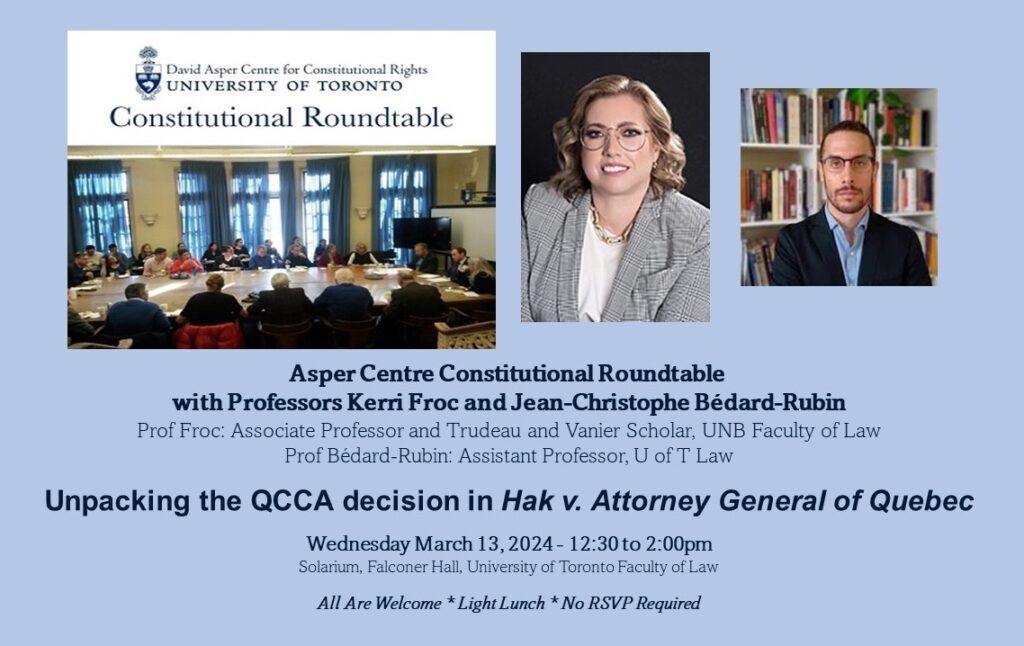
Constitutional Roundtable with Professors Kerri Froc and Jean-Christophe Bédard-Rubin on the QCCA decision in Hak v. Attorney General of Quebec

The Asper Centre Constitutional Roundtables are an annual series of lunchtime discussion forums that provide an opportunity to consider developments in Canadian constitutional theory and practice. The series promotes scholarship and aims to make a meaningful contribution to intellectual discourse about Canadian and comparative constitutional law.

We are pleased to host Associate Professor Kerri Froc (UNB Law) in conjunction with Assistant Professor Jean-Christophe Bédard-Rubin (U of T Law) for a Constitutional Roundtable on March 13, 2024 in the Solarium, Falconer Hall, Faculty of Law.

Professors Froc and Bédard-Rubin will break down the Quebec Court of Appeal’s decision in Hak et al. c. Procureur général du Québec, concerning the constitutionality of Bill 21, An Act Respecting the Laicity of the State. This appeal concerns freedom of expression, freedom of religion and equality rights, as Muslim women in Quebec who wear religious symbols such as the niqab or hijab would be prohibited from working in certain professions and in most parts of public administration, and prevented from benefitting from some public services because the law requires them to do so with their faces uncovered. The government of Quebec also pre-emptively used the override clause to prevent any constitutional challenges to the legislation. This Constitutional Roundtable will cover what this decision means for Charter rights, gender equality, and state use of the “notwithstanding clause.”

Kerri Froc is an Associate Professor at UNB Law, as well as a Trudeau and Vanier Scholar. She has taught courses at Carleton University, Queen’s University and University of Ottawa on feminist legal theory and various aspects of public law, among others.

Kerri received her PhD from Queen’s University in 2016 and holds a Master of Laws from the University of Ottawa, a Bachelor of Laws from Osgoode Hall Law School and a Bachelor of Arts from the University of Regina.

Before completing her doctorate, she spent 18 years as a lawyer, as a civil litigator in Regina, a staff lawyer for the Women’s Legal Education and Action Fund (LEAF), and as a staff lawyer in the areas of law reform and equality at the Canadian Bar Association. She is a member of the Saskatchewan and New Brunswick bars.

Assistant Professor Jean-Christophe Bédard-Rubin’s work explores Canadian constitutional culture from historical and comparative perspectives. He studied law, political science, and philosophy at Université Laval, Yale University, and the University of Toronto. During his doctoral studies, Jean-Christophe was the McMurty Fellow of the Osgoode Society for Canadian Legal History and a Joseph-Armand Bombardier Scholar. He has done consultancy work on constitution-building for International IDEA and, prior to his graduate studies, he worked in litigation for the Quebec Department of Justice.

Bédard-Rubin currently pursues two main research projects. The first is an intellectual history of the foundations of public law in French Canada. This project seeks to reconstruct the intellectual networks in which French Canadian public lawyers participated to excavate the transatlantic influences on the formation of Quebec’s legal syncretism. This genealogical reconstruction recovers the conceptual and theoretical innovations that allowed French Canadians to articulate a genuine theory of the state outside of the revolutionary framework. In so doing, this work sheds a different, somewhat oblique light on Canada’s constitutional experience and questions its status in comparative constitutional scholarship.

The second research project investigates judicial bilingualism in Canada. Using mixed social science methods, this project explores the various empirical impacts of bilingualism on judicial behaviour, the normative significance of legal bilingualism for the authority of judicial decisions, and the ways in which language shapes the dominant conception of the judicial role in Canada’s French and English public spheres.

Jean-Christophe’s work has been published in English and French in the Review of Constitutional Studies, the Canadian Journal of Law & Society, the Osgoode Hall Law Journal, the Bulletin d’histoire politique, and the International Journal of Canadian Studies, amongst others.

All are welcome * Light lunch provided * No registration required

Constitutional Roundtable on City of Toronto et al v Ontario

by: Bailey Fox

On Tuesday November 9, 2021 the Asper Centre hosted a constitutional roundtable panel on the Supreme Court’s recent decision in City of Toronto et al v Ontario, 2021 SCC 34. The Asper Centre intervened in the appeal at both the Ontario Court of Appeal (OCA) and the Supreme Court of Canada (SCC). The panelists for the constitutional roundtable included lawyers and academics who had participated in the appeal: Geetha Philipupillai, lawyer at Goldblatt Partners LLP and counsel for the intervener Canadian Civil Liberties Association in the SCC appeal; Professor Lorraine Weinrib, Professor Emerita at the University of Toronto Faculty of Law and a specialist in constitutional law and litigation; and Alexi Wood, of St. Lawrence Barristers LLP, counsel for the Asper Centre in its intervention at the OCA and the SCC. The panel was moderated by Lillianne Cadieux-Shaw, of St. Lawrence Barristers LLP, co-counsel for the Asper Centre in its intervention at the SCC.

Lillianne Cadieux-Shaw began the discussion with a summary of the facts and issues in the case. In short, the Supreme Court considered whether the Better Local Government Act, SO 2018, c 11 (the Act) – enacted by Ontario’s provincial government during the City of Toronto’s municipal election – which cut the number of city wards violated freedom of expression. The Court also discussed the role of unwritten constitutional principles in constitutional interpretation. In a 5-4 split decision, the SCC held that the Act did not violate candidates’ freedom of expression. A fuller discussion of the case be found on the Asper Centre’s blog here.

The panelists discussed the many important ramifications of the case for constitutional interpretation and litigation. Professor Weinrib noted that the case may revolutionize the freedom of expression guarantee because the Court de-emphasized the purposive approach to Charter interpretation. Instead, the Court underscored the Baier framework and its more technical positive/negative rights analysis. Alexi Wood noted that it would likely be more difficult to prove a breach of s2.(b) going forward, noting that in the context of preparing for freedom of expression litigation, lawyers will have to carefully frame the claim based on a positive/negative rights distinction. Geetha Philipupillai added the insight that this may lead to more claims based on the Charter’s s.15 guarantee of equality or s.2(d) right to freedom of association given that the current legal test for breach of these provisions does not distinguish between positive and negative claims.

A recurring thread throughout the Roundtable was a comparison between the majority and dissent in the decision. The dissenting opinion, penned by Justice Abella, would have applied the framework for proving a breach of s.2(b) from Irwin Toy v Quebec, [1989] 1 SCR 927 and found that the Act violated freedom of expression. As Professor Weinrib noted, the strong dissent also highlighted the radical change in the majority’s approach to the scope of s.2(b). Professor Weinrib was referring to a broader recent shift in the Courts jurisprudence that narrows the scope of Charter guarantees, based on the SCC’s concern that the existing legal tests are too broad and the test for justifying a breach under s.1 too difficult for governments to meet. During the discussion on the role of evidence in the case, Alexi Wood noted that the Majority’s choice to advance the positive/negative rights framework was facilitated by the majority’s move away from the facts of the case. Conversely, the dissenting opinion was much more fact-specific, partially because the Irwin Toy framework requires an analysis of the facts. In comparing the two sets of reasons throughout the discussion, the Panelists usefully highlighted the extent of the ideological cleavage on the Court as well as the implications of the majority’s departure from the Irwin Toy test.

The Panel also touched on the role unwritten constitutional principles and the place of municipalities in Canada’s constitutional framework. Overall, the discussion between scholars and practitioners, all involved in the case, highlighted some important implications about the case from both an academic and practical perspective. It both put the decision in broader context while helping attendees understand the implications of the case for both freedom of expression specifically and constitutional litigation more broadly going forward.

View the webcast of this Constitutional Roundtable HERE.

Bailey Fox is a Research Assistant with the Asper Centre and is currently an LLM student at the University of Toronto, Faculty of Law. 

The Positives of Campaigning: City of Toronto and Freedom of Expression at the Supreme Court

by Bailey Fox

Introduction

On October 1, 2021, the Supreme Court of Canada (SCC) released its decision in Toronto (City) v Ontario (Attorney General), 2021 SCC 34 [City of Toronto]. In the 5-4 decision, the Supreme Court held that the legislation that reduced the size of Toronto City Council during an ongoing municipal election did not violate the Constitution’s guarantee of freedom of expression. The Court also held that unwritten constitutional principles cannot, on their own, invalidate legislation.

The Asper Centre intervened in the case, specifically on the issue of the scope of freedom of expression in the context of municipal elections. The decision, while resolving the immediate dispute, raises many new questions about the future of the Charter of Rights and Freedoms’ s.2(b) guarantee of freedom of expression. The divide between the majority and dissenting opinion on the role of unwritten constitutional principles also highlights the existing divide between the Supreme Court’s judges regarding Charter interpretation.

Background

On July 27, 2018, shortly after being elected, the Ontario government tabled the Better Local Government Act, SO 2018, c 11 [BLGA]. The BLGA reduced the number of wards in the City of Toronto from 47 to 25 during the City’s ongoing election. The BLGA upended the election, eliminating 22 wards and requiring candidates to pivot their campaigns to new or unfamiliar districts.

Shortly after being enacted on August 14, 2018, a number of parties, including affected candidates and the City of Toronto brought an application seeking to invalidate the BLGA. The parties advanced a few constitutional arguments, including that the BLGA violated ss.2(b) and s.15(1) (equality rights) of the Charter, as well as the unwritten constitutional principles of democracy and the rule of law. The application was heard on an expedited basis on September 9, 2018. In City of Toronto et al v Ontario (Attorney General), 2018 ONSC 5151, the application judge held that the BLGA violated both candidates’ and electors’ s.2(b) rights and could not be justified under s.1 of the Charter. Given the s.2(b) violation, the application judge held that it was not necessary to consider the role of unwritten constitutional principles. The application judge invalidated the legislation and restored the 47-ward format for the election.

The government sought an appeal, and an urgent stay, of the application judge’s decision at the Ontario Court of Appeal (OCA). In its stay decision, the OCA found that candidates were seeking a positive right to a particular platform, and held that the BLGA did not substantially interfere with expressive freedom. Based on the stay decision, the BLGA remained in force and Toronto’s election proceeded on a 25-ward basis.

A little over a year later, the appeal was heard and decided on its merits. The Asper Centre intervened in the appeal. In Toronto (City) v Ontario (Attorney General), 2019 ONCA 732, the OCA reversed the application judge’s decision and affirmed the constitutionality of the BLGA. Justice Miller, writing for the majority, characterized the claim as a positive one – that the claimants were seeking access to a statutory platform as opposed to freedom from government interference in electoral expression. Applying the case of Baier v Alberta, 2007 SCC 31 [Baier], the Court held that the claimants must demonstrate a substantial interference with freedom of expression but have failed to do so since the government is not required to ensure the effectiveness of expression.

In dissent, Justices Nordheimer and MacPherson would have denied the appeal on a finding that the BLGA violated all electoral participants’ s.2(b) rights. The dissenting justices largely adopted the submissions of the Asper Centre on this point.

The City of Toronto appealed the OCA’s decision.

The Supreme Court’s Decision

Majority

Chief Justice Wagner and Justice Brown wrote the 5-judge majority decision. Like the OCA, the SCC characterized the claim as a positive one, that is that the claimants were seeking access to a particular statutory platform (a 47-ward council). Noting that this appeal was an opportunity to ‘affirm and clarify’ the Baier framework, the Court held that when claimants are seeking to impose an obligation on the government to provide access to a statutory platform for expression, the s.2(b) claim is a positive one (para 24). In such cases, the claimant must demonstrate that lack of access to a statutory platform has substantially interfered with, or “radically frustrated”, expression to such an extent that expression is “effectively precluded” (para 26).

Applying the Baier framework, the Court held that the claim was a positive one, however the City had not demonstrated substantial interference with expression. The Court noted that the Act did not prevent candidates from engaging in political speech or impose conditions on the content or meaning of speech. The Court rejected submissions that the BLGA rendered prior campaigning meaningless, noting that government action that makes prior speech less effective is not a substantial interference with s.2(b). The Court concluded that candidates’ freedom of expression was not radically frustrated and therefore the BLGA did not violate s.2(b).

On the question of the role of unwritten constitutional principles in Charter interpretation, the Court held that these principles – like democracy and the rule of law – could be used for exactly that, and nothing more. Adopting a textual approach to constitutional interpretation, the Court held that unwritten constitutional principles represent general principles underlying the constitutional order, and while they may assist the Court as interpretative tools or to develop structural doctrine, these principles do not have independent legal force.

Dissent

Justice Abella penned the reasons on behalf of the four dissenting judges. They would have allowed the appeal based on a finding that the BLGA violated s.2(b) of the Charter.

The dissent rejected the Baier framework and would have applied the test for a s.2(b) violation from Irwin Toy Ltd v Quebec, [1989] 1 SCR 927 [Irwin Toy]. Justice Abella noted that Baier only applies to circumstances where an existing statutory platform is underinclusive, and characterized the claim in this case as government interference with expressive rights attached to an electoral process (para 151). Applying the Irwin Toy framework, Justice Abella held that the BLGA’s timing “interfered with the rights of all participants in the electoral process to engage in meaningful reciprocal political discourse” (para 157). Justice Abella held that since the government had not provided any justification for the legislation’s timing, it could not be saved under s.1.

Justice Abella also commented on the role of unwritten constitutional principles, holding that they are independent of, and form the backdrop to, the written text of the constitution. These principles represent society’s normative commitments and therefore have independent legal force. Per the dissent, in rare cases, unwritten constitutional principles may invalidate legislation that has otherwise escaped the reach of an express constitutional provision.

Where do we go from here?

The majority’s critique of Irwin Toy and affirmation of Baier is notable and perhaps concerning. The majority notes at para 14 that Irwin Toy “has been criticized for setting too low a bar for establishing a s. 2(b) limitation…”. The analysis then continues with a discussion of s.2(b)’s internal limits, the distinction between positive and negative claims, and an affirmation of Baier. While this is a legitimate and existing critique of Irwin Toy, the Court does not expand on why such a broad test is at odds with the text of s.2(b), is normatively problematic, or why or whether it should be changed. However, the Court’s decision has the effect of limiting the applicability of the Irwin Toy framework, and potentially narrowing the scope of s.2(b), and thus adding complexity to s.2(b) litigation. As noted in the dissent at para 155, claimants must now meet a preliminary burden of demonstrating that their s.2(b) claim is a negative entitlement. Adding this inquiry to the s.2(b) analysis is especially concerning given that the distinction between positive and negative entitlement is easily malleable (again, a critique noted by the dissent at para 152 and previous SCC jurisprudence).

Also of note is the very high bar the Court states is required to establish a s.2(b) violation under Baier/City of Toronto. To succeed under this framework a claimant must show that lack of access to a statutory platform has radically frustrated expression to the extent that it is effectively precluded. The substantial interference standard (which was imported from the freedom of association jurisprudence and has since been impugned in that context; see City of Toronto at para 21) thereby recognizes that some interference with expressive freedom is constitutionally permissible. City of Toronto ignites a latent question about s.2(b)’s internal limits and elevates the bar that claimants must meet if a Court considers the claim a positive one.

The decision’s discussion of unwritten constitutional principles also reflects an ongoing divide among SCC judges between a textual and liberal/purposive interpretation of the Charter. While both opinions resolved the dispute on s.2(b) grounds, they nevertheless included a sustained discussion in obiter on unwritten constitutional principles. The majority subscribes a limited role for purposive interpretation, and later notes that notes that unwritten constitutional principles may assist with constitutional interpretation, but only where the test is not sufficiently definitive (para 65). But what is notably absent is any engagement by the majority with the purpose of s.2(b), or the impact of the principle of democracy on the analysis of a case where the scope of s.2(b) is at issue. While Justice Abella recognizes that freedom of expression includes the right to engage in political discourse (paras 114 – 122), the relevance of political discourse or the election context takes a backseat in the majority’s decision. This, in addition to emphasizing the distinction between a positive and a negative claim, is a marked departure from earlier jurisprudence like Irwin Toy that emphasized the purpose of freedom of expression, and  its connection to political discourse, and a broad scope for s.2(b).

In conclusion, the case that came to the Supreme Court was concerned with mid-election reform to Toronto City Council’s structure. However, in destabilizing the s.2(b) framework and narrowing the applicability of unwritten constitutional principles, the SCC’s decision leaves constitutional litigators, scholars, and students with many questions about the future of s.2(b) and constitutional interpretation.

Bailey Fox is a Research Assistant with the Asper Centre and is currently an LLM student at the University of Toronto, Faculty of Law.