Skip to content

Unbiased Policing and the Legalization of Cannabis

by Jasmit de Saffel

On October 18th, 2018 two Toronto Police Service (TPS) Sergeants came to the University of Toronto law school to present about the comprehensive training police officers go through to reduce their implicit biases on the job. The presenters were engaging, introspective and candid about the mistakes Toronto Police has made in the past. They also agreed that policing is a profession that cannot afford “bad apples”.

The Sergeants’ explanation of the Police and Community Engagement Review (PACER) conducted by the Toronto Police Service beginning in 2012 was indicative of the TPS’s desire to address past issues with implicit bias. The PACER report made extensive recommendations, one of which was implementing the Fair and Impartial Policing (FIP) program, a bias mitigation program developed by a notable expert on bias in policing, Dr. Lorie Fridell of the University of South Florida. The FIP program is based on the modern science of bias, consistent with the TPS’s current focus on evidence-based policing and policy development. All new and existing officers go through the Fair and Impartial Policing program, which focuses on understanding human bias, the science of bias, the impact of bias policing, managing implicit bias, and addressing the biases of others. The Toronto Police Service’s implementation of the program has been successful enough to warrant an invitation from the program creators to help tweak it further.

Despite the presenters’ extensive insight and understanding of the dangers implicit bias poses in law enforcement, the Sergeants prefaced their talk by stating that they were not going to talk about cannabis. This left me a bit dumbstruck, especially after having attended the “Perspectives on Cannabis” panel discussion presented as part of the law school’s Emerging Issues workshop series the week before. The panelists there, criminal lawyer Stephanie DiGiuseppe, sociologist Dr. Akwasi Owusu-Bempa and our own Professor Kent Roach, were explicit about the negative impacts of Canada’s cannabis prohibition on racialized and Indigenous communities. They emphasized the long-lasting and adverse effects on the lives of those affected by the biased and discriminatory policing of cannabis.  In light of these realities, how could you not discuss cannabis at an implicit bias in policing presentation on the day after federal legalization of cannabis?

Ironically, the Cannabis Act has actually created more laws around cannabis than existed before. Under the Controlled Drugs and Substances Act there were eight cannabis-related offences, including possession, trafficking, exporting, and importing. The Cannabis Act has both increased the number of possible offences, and made the penalties stiffer. These offences include, but are not limited to, public possession of more than an ounce, unauthorized promotion, and sharing cannabis with a minor. Sharing with a minor has a potential 14 year jail term attached to it, promoting to youth can get you a $5 million fine, and possession over the limit can still mean 5 years in jail. The Act has also created a category of “illicit cannabis,” which includes any products not purchased from an authorized retailer or grown legally. While adults are able to recreationally use cannabis, they are only able to do so within this strict web of regulations.

I was hoping to hear about the TPS’s plan to reduce their implicit biases in enforcing the new Cannabis Act regulatory scheme. The vagueness and confusion about what legalization practically looks like has raised concerns about the potential for old habits of discriminatory law enforcement to persist. These concerns are amplified in light of the fact that uncertainty about legal cannabis consumption leaves a lot to the discretion of individual police officers. An obvious example is the fact that no standardized test has been accepted for determining whether someone is driving impaired. How will police officers ensure that they are not making decisions about impairment based on their implicit biases? Ambiguity also exists about where cannabis can be used, how minors will be identified, how illicit cannabis will be recognized, how immigration status will be affected etc. All this means is that the implementation of the Cannabis Act can very easily continue to disproportionately affect historically marginalized demographics.

It is entirely unrealistic to assume that the biases that led to the over-representation of racialized and Indigenous Canadians with criminal records for cannabis-related offences disappeared as the clock struck midnight on October 17.  In fact, research from other jurisdictions that have legalized cannabis has shown a decrease in overall cannabis-related arrests, but no decrease in the gap between racialized and white arrests.  The reality of the situation is that an annual training is likely not going to undo a lifetime of preconceived notions and understandings of the world. It is also not going to erase the decades of friction cannabis prohibition has caused between the police and marginalized groups in Toronto.

These concerns are not meant to criticize the TPS Sergeants’ presentation specifically. The TPS’s vision, as articulated in its PACER report, is making the Toronto Police Service a leader in bias-free police service delivery and their dedicated implementation of the Fair and Impartial Policing program is an excellent first step in doing this. The candour of the two presenters also suggested a genuine desire to improve the relationship between the TPS and the city. However, the anti-bias program described lacks the accountability and enforcement mechanisms required to make it effective in changing attitudes and behaviours. While it was a good presentation to give a room of privileged law students, I am not sure how it would resonate in neighbourhoods that have been adversely affected by biased police practices.

A city as diverse and complex as Toronto needs a police service that represents, respects and protects all of its residents and can in turn be held accountable by them. As the city adjusts to the legalization of cannabis and all the regulations that come with it, the TPS is presented with an excellent opportunity to prove its commitment to reducing biases in policing. Toronto can lead by example and demonstrate that it is possible to police cannabis legalization in a just and equitable manner. Doing so will require widespread education about the new cannabis regulations, robust accountability mechanisms for law enforcement officers, an open dialogue between historically marginalized communities and the TPS and a demonstrated and genuine desire by the police to atone for past injustices.

Jasmit de Saffel  is a 1L JD Candidate at the Faculty of Law and is the current Asper Centre work-study student
Reflections at the Asper Centre’s Ten Year Anniversary Event


by Josh Foster

On October 17th, the University of Toronto Faculty of Law opened its doors in celebration of the David Asper Centre for Constitutional Rights’ 10th Anniversary. To borrow from the submissions of Joseph Arvay in Carter v Canada (Attorney General), the Asper Centre’s 10th Anniversary was a “momentous occasion”.  

Founded through the generous donation of UofT Law alumnus David Asper (LLM ’07), the Asper Centre has marshalled students, faculty and members of the bar toward advancing Canadian constitutional law, and access to constitutional rights since September 2008. This effort has afforded the Asper Centre the opportunity to intervene on multiple constitutional appeals, twenty of which have been before the Supreme Court. These appeals have included such noteworthy cases as: Conway v Her Majesty the Queen, et alPrime Minister of Canada et al. v Omar KhadrAttorney General of Canada v Downtown Eastside Sex Workers United Against Violence Society and Sheryl Kiselback, and Canada v Bedford. In addition to its role as an intervenor, the Asper Centre has prepared policy briefs for numerous Senate Standing Committees, hosted panel discussions on topical constitutional issues, and contributed to legal scholarship.  

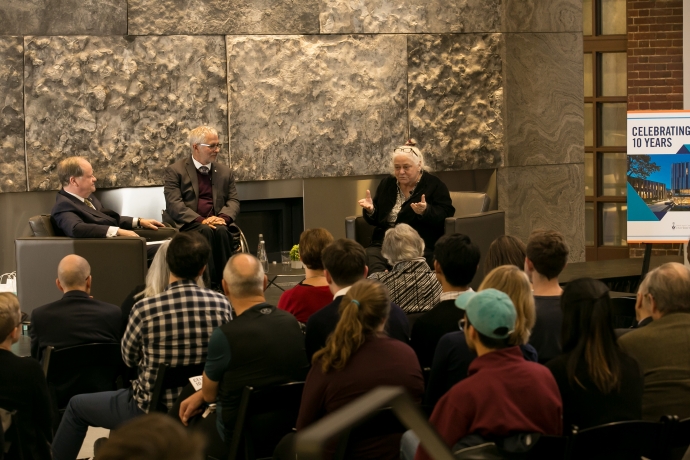
In recognition of the Asper Centre’s dedication to legal advocacy, education, and research, the Faculty of Law hosted a discussion between Mary Eberts and Joseph Arvay. Eberts, a former Asper Centre Constitutional Litigator-in-Residence, has acted as counsel to parties and intervenors at all levels of court and before administrative tribunals and inquests.  Further, she advocated for the present language of section 15 of the Charter, and was one of the founders of the Women’s Legal Education and Action Fund (LEAF). Since 1991, Eberts has been litigation counsel to the Native Women’s Association of Canada (NWAC). Arvay, the first Constitutional Litigator-in-Residence for the Asper Centre, is recognized as one of Canada’s foremost constitutional litigators. In 1990, he co-founded the firm of Arvay Finlay Barristers and has been awarded honourary doctorates of law from both York University and the University of Victoria. Together, Arvay and Eberts have appeared before the Supreme Court in more than fifty constitutional appeals. Both were made Officers of the Order of Canada this year for their work. 

The discussion between Eberts and Arvay, moderated by former Supreme Court of Canada Justice Thomas Cromwell, focused on wide-ranging topics relevant to public interest litigation, five of which are highlighted here.  

First, Eberts and Arvay shared their views on early Charter jurisprudence as well as the development of the s. 15(1) equality guarantee. By now it is clear that the Supreme Court’s interpretation of s. 15(1) has been inconsistent. However, both Eberts and Arvay agreed that it has now stabilized. Importantly, Eberts would welcome greater judicial consideration for the meaning of “equal protection and equal benefit of the law” within the equality guarantee.  

Second, Eberts and Arvay were asked to express their views on the development of Aboriginal law and Indigenous rights. Notwithstanding the progress made through cases like Delgamuukw v British Columbia and Tsilhqot’in Nation v British Columbia, the Asper Centre’s distinguished speakers agreed that there is more to be done. For instance, Eberts suggested that s. 35 of the Constitution Act, 1982 has been thus far, interpreted too narrowly. Moreover, greater regard must be had for the role of “the emerging Indigenous nations in Canadian federalism”. From the perspective of counsel for Indigenous litigants, Arvay articulated the difficult task of seeking relief from Canadian courts while limiting the room for those same courts to make pronouncements on Indigenous law.  

Third, Cromwell asked Eberts and Arvay to share their opinions on the role of interveners in constitutional litigation. Of course, having acted as counsel for numerous interveners, each were well positioned to answer. For both Eberts and Arvay, interveners play an integral role to constitutional litigation, namely, ensuring that all interests/perspectives relevant to an issue are fairly represented. Unfortunately, the Supreme Court’s continued shift toward minimizing the time given for interveners to make oral submissions tempers their efficacy and utility. The Asper Centre, as a frequent intervener in the Supreme Court has equally been impacted by these temporal limitations.   

Fourth, and perhaps most surprisingly, Eberts and Arvay expressed their views on large law firm environments and whether they are conducive to pubic interest litigation. The fact that most public interest litigation is done on a pro bono basis presents an obvious challenge to any private practice, including large firms. Drawing on their respective experiences in large firms, both Eberts and Arvay suggested that they can serve as excellent environments to facilitate public interest and constitutional litigation. With that said, young lawyers in these settings must be careful not to over commit to pro bono litigation and thereby become unable to meet competing demands.  

Lastly, Eberts and Arvay explored their experiences in seeking advanced or special costs orders. For Eberts and Arvay, the law on advanced costs is in an unsatisfactory state. A failure to receive advanced costs for litigants is at the least disheartening and at the worst, prohibitive of meritorious claims. Presently, the bar for granting an advanced costs order is simply too high while revealing the financial vulnerability of the moving party.  

In summary, the Asper Centre’s 10th Anniversary celebration was an engaging and informative event. Mirroring the Asper Centre’s mandate, the questions posed to its esteemed guests were oriented around topical issues in constitutional law and access to constitutional rights. At the Direction of Cheryl Milne, and with the support of its Program Coordinator, Tal Schreier, as well as UTLaw’s faculty and students, the Asper Centre has made significant strides in advancing constitutional rights, research and public policy in Canada. Further, the Asper Centre’s involvement in constitutional advocacy initiatives and litigation has provided students with the opportunity to gain practical experience under the tutelage of experienced advocates such as Mary Eberts and Joseph Arvay.

Josh Foster is a 3L JD Candidate at the Faculty of Law and an Asper Centre Clinic alumnus

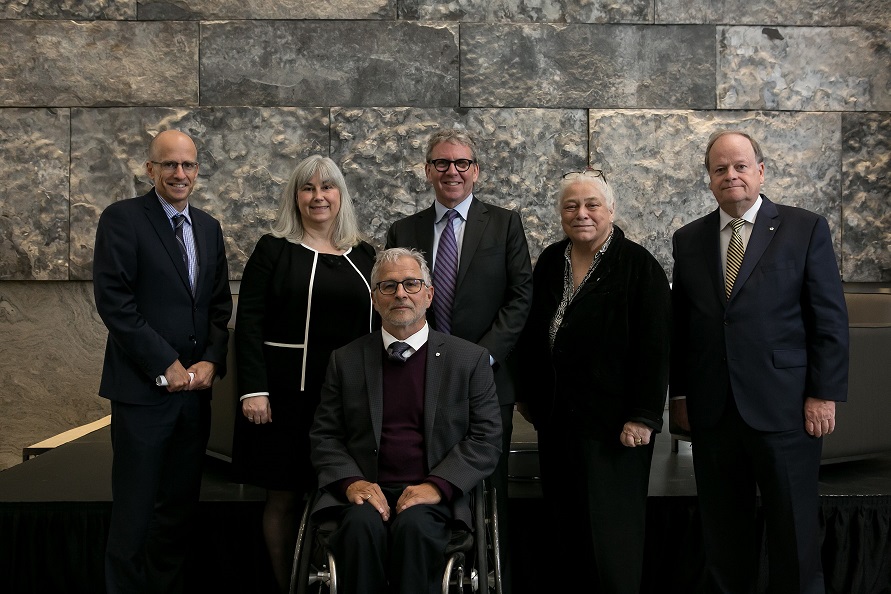
From L to R, Dean Ed Iacobucci, Cheryl Milne, Joseph Arvay (sitting), David Asper, Mary Eberts, and Thomas Cromwell (photos by D. Chang)

Implementing UNDRIP: Opportunities and Challenges

By Catherine Ma

On October 22, 2018, the Faculty of Law’s Office of Indigenous Initiatives hosted Professor Brenda Gunn to discuss the United Nations Declaration on the Rights of Indigenous Peoples (“UNDRIP”). Her presentation primarily focused upon the opportunities and challenges related to implementing UNDRIP in Canada.

UNDRIP enshrines the individual and collective rights of Indigenous peoples in relation to culture, identity, language, education, employment, health, and other issues. These rights are the bare minimum rights of Indigenous peoples; in other words, states are free to recognize stronger rights than those articulated in UNDRIP. Nevertheless, UNDRIP is monumental document since Indigenous peoples directly participated in drafting its provisions. Its adoption signalled a recognition and protection of Indigenous peoples’ rights within the United Nations and international legal systems.

Professor Gunn endorsed Bill C-262 as a framework for implementing UNDRIP. This bill would state affirmatively that UNDRIP applies in Canada; require the federal government to ensure all domestic laws are compliant with UNDRIP, develop and implement a national action plan for achieving UNDRIP’s articles, and report annually to Parliament regarding its progress; as well as clarify that UNDRIP does not diminish or extinguish any §35(1) rights. Professor Gunn emphasized that a national action plan is essential to ensure that different Indigenous peoples can pursue their rights as they understand them. She further suggested that human rights commissions can have an “active role” in promoting UNDRIP and mediating between the Canadian state and Indigenous Peoples.

Professor Gunn asserted that the scope of §35(1) rights must be reconsidered; at a minimum, §35(1) rights must include the rights enshrined in UNDRIP. She reasoned that R v Van der Peet is no longer authoritative law, as §35(1) cannot only protect activities that are “central and integral to the distinctive community practiced continually since contact.” §35(1) must protect all practices, traditions, and customs that are connected sufficiently to the self-identity and self-preservation of Indigenous nations.

UNDRIP at the Asper Centre

The Asper Centre has a dedicated Indigenous Rights Student Working Group (“IRSWG”) that focuses on the constitutional dimension of Indigenous rights. This year, the IRSWG will analyze UNDRIP and Bill C-262 with the intent of drafting general recommendations and observations about actions that ought to be taken in order to implement UNDRIP. This project will examine how UNDRIP affects different legal and policy areas. The group’s other projects include drafting proposed legislation to exonerate Indigenous peoples who were convicted for practicing their ceremonies under past legal regimes; and examining Beaver v Hill for the §35(1) governance issues in relation to Haudenosaunee law and family law.

It will be fascinating to follow the IRSWG’s progress on these projects as the year unfolds.

Catherine Ma is a 3L JD Candidate at the Faculty of Law and was a student leader of the Asper Centre’s Indigenous Rights student working group in 2017-2018. 

Celebrating 10 years with a special constitutional law panel, and a $2.5 million gift from namesake, David Asper

Panelists former SCC Justice Thomas Cromwell with Joseph Arvay and Mary Eberts

Constitutional panel includes the former SCC Justice Thomas Cromwell moderating, with Joseph Arvay and Mary Eberts as panelists.

By Lucianna Ciccocioppo / Photography by Dhoui Chang

You can accomplish a lot in 10 years, with strategic vision and leadership, enthusiastic support and some pretty bright  law students — and that’s exactly what the David Asper Centre for Constitutional Rights did: 46 constitutional roundtables, 21 student working groups, 20 interventions at the Supreme Court of Canada, 10 conferences and symposia and seven Constitutional Litigators-in-Residence.

The Asper Centre is celebrating 10 years of advocacy, legal research and student clinic work with a litany of achievements in its first decade, a special panel discussion with top litigators in the constitutional bar – and a gift of confidence from its benefactor, David Asper, to ensure the centre’s viability for years to come.

“I’m actually amazed at how much they’ve done in a relatively short period of time,” said Asper who attended the anniversary event at the Faculty of Law on Oct. 17, 2018.  “It takes awhile to start a centre, and then it takes time to earn credibility across the country and with the courts, and it’s very impressive how they’ve been able to do that.”

Asper donated $2.5 million, as part of the Campaign for Excellence without Barriers, to fund the David Asper Bursary, and to guarantee the future of the one-of-a-kind Asper Centre, the only constitutional advocacy and research centre at a law school with experiential learning for students. This gift is in addition to the $7.5 million Asper donated in 2007, then the largest individual gift to the Faculty of Law, and which kick-started the building campaign and launched the centre.

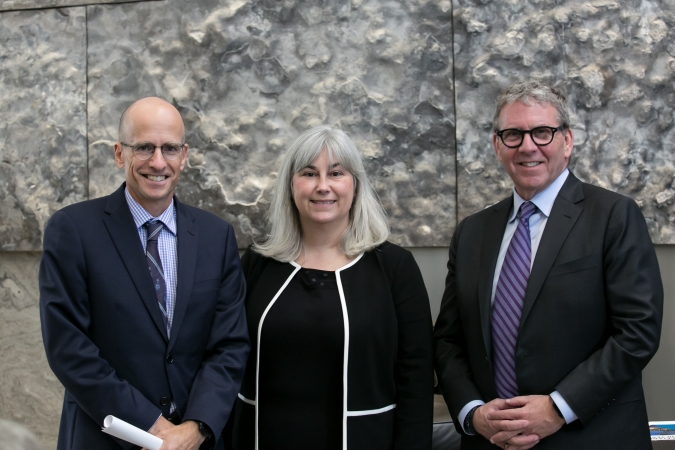
Dean Ed Iacobucci with Cheryl Milne and David Asper

Supporting the Campaign for Excellence without Barriers: Dean Ed Iacobucci, Executive Director Cheryl Milnewith benefactor and alumnus, David Asper

A LLM graduate of the Faculty of Law and a prominent criminal defense lawyer, Asper successfully represented David Milgaard in overturning one of Canada’s most notorious wrongful conviction cases. After the cancellation of the Federal Court challenges program, which occurred during his graduate studies here, Asper stepped up and conceptualized its replacement, and it took only one year to hit the ground running in its advocacy work.

Executive Director Cheryl Milne has led the centre since its opening and has grown the program significantly. As part of the anniversary event, a panel discussing Canada’s constitutional top issues, was moderated by former Supreme Court Justice Thomas Cromwell and in conversation with two of the country’s top constitutional lawyers, Joseph Arvay and Mary Eberts. Arvay and Eberts, who received Orders in Canada this year, were also among the centre’s prominent Constitutional Litigators-in-Residence program, and shared the breadth and depth of their legal expertise and skills with law students in experiential clinics. John Norris, Raj Anand, Janet Minor and Breese Davies were also Constitutional Litigators-in-Residence and the current resident is Susan Ursel.

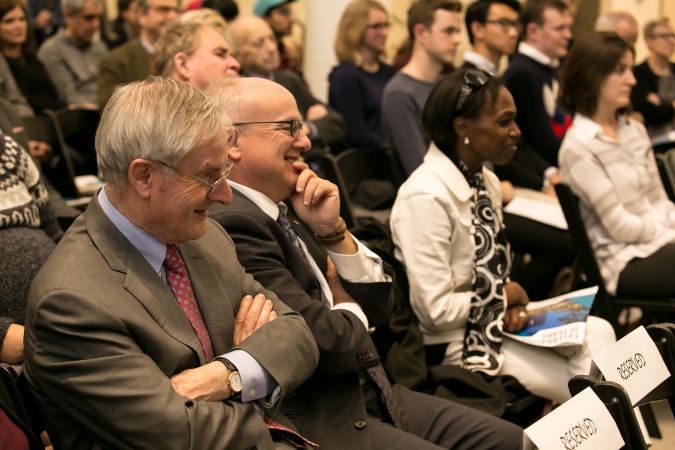
Crowd shot at the Asper Centre panel

As Dean Iacobucci and Cheryl Milne said in their opening remarks, the centre has collaborated with prominent political scientists from the University of Toronto and across Canada and has written on the state of Canada’s democracy, the role of unwritten constitutional conventions and how the Canadian government works. It has made submissions to government committees on legal issues ranging from the privacy rights of jurors and various amendments to the criminal code. The centre’s ground-breaking work also includes pioneering clinical legal pedagogy, including incorporating reflective learning and legal project management into constitutional work.

Asked which Asper Centre achievement made him most proud, David Asper said there are more than one. “It begins with the Wardcase, where the concept of damages for breach of the Charter was first litigated.  And then as it was applied in Henry, in wrongful conviction cases, that was particularly near and dear to my heart. But I think the breadth of not only the cases being litigated but the dialogue being generated by the centre which is often times effective, or as effective as litigation, covers the spectrum.”

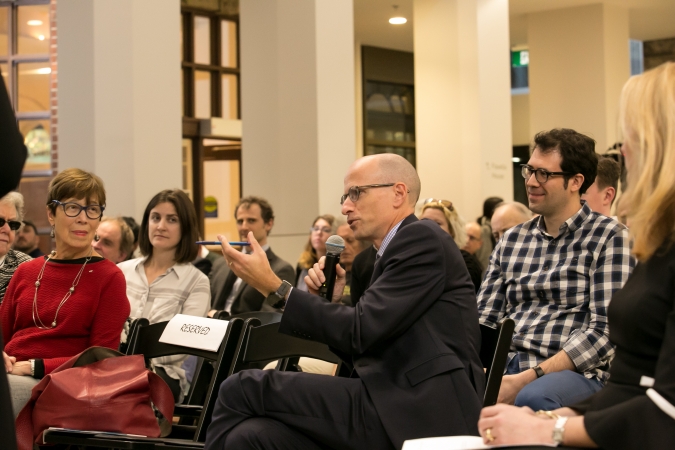
Crowd shot and Dean Iacobucci asks a question

About 100 people turned out to celebrate the anniversary event, and the Asper Centre’s success. Added David Asper:  “You’ve heard from the panellists today: the old timers get energized when we engage with the students. We get inspired. We think differently. We get fresh approaches and then you see it come full circle when they are in the Court themselves.  So it’s very heartwarming… and I can sit back and enjoy the success.”

Watch the video

Above the Law? Understanding the Notwithstanding Clause

By Catherine Ma

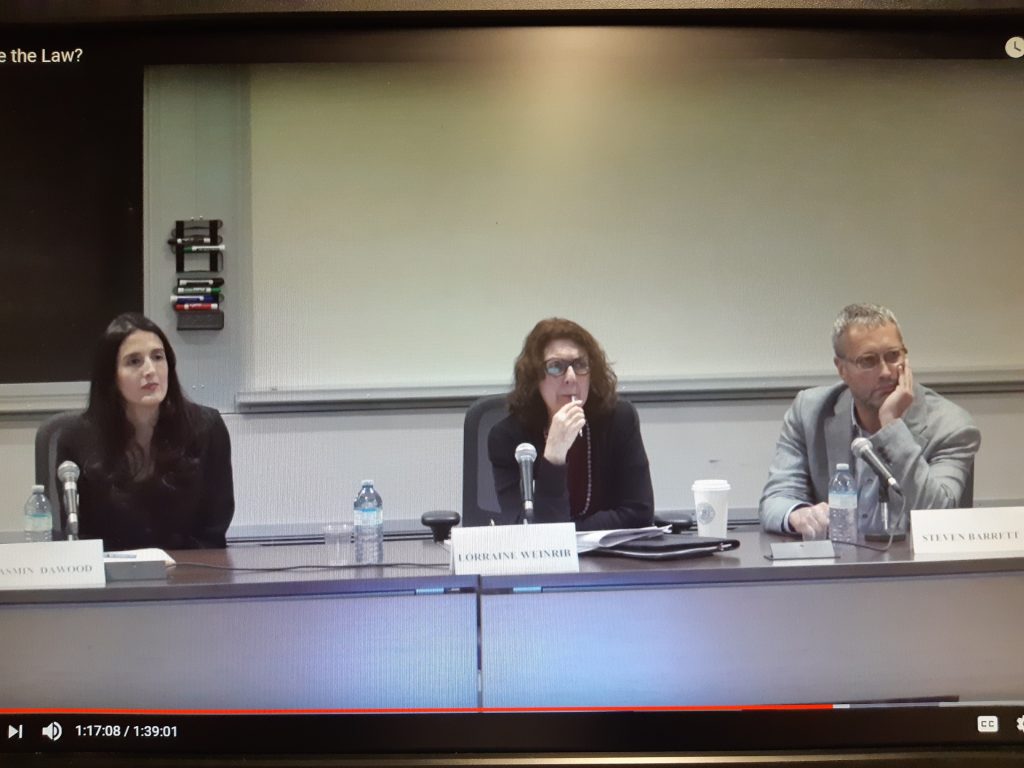
On September 20, 2018 the David Asper Centre for Constitutional Rights convened a panel with U of T Law Professors Yasmin Dawood and Lorraine Weinrib, and Goldblatt Partners’ Steven Barrett to discuss the constitutional challenge to the Better Local Government Act. The proposed legislation would have reduced the size of Toronto’s city council in the midst of its municipal election, as well as ending mandatory election of regional councillors across all regional municipalities. Superior Court Justice Edward Belobaba struck down the legislation, finding that it was an unjustified infringement to s.2(b) of the Charter. The Court of Appeal of Ontario ultimately granted a stay of the Superior Court’s decision until a full appeal could be heard after the election. Its effect was allowing the Better Local Government Act to govern the 2018 municipal elections in Ontario.

Before the Court of Appeal rendered its decision, Ontario’s Premier Doug Ford had threatened to invoke the notwithstanding clause if a stay was not granted. The notwithstanding clause allows the federal government or a provincial government to enact legislation that overrides certain fundamental freedoms, legal rights, and equality rights guaranteed in the Charter. Premier Ford further warned that he would not hesitate to use the notwithstanding clause in the future, without providing specific details.

The Panel Discussion

The panelists all provided unique perspectives regarding the constitutional challenge to the Better Local Government Act and the notwithstanding clause itself.

Above the Law panelists: Prof Yasmin Dawood, Prof Lorraine Weinrib, Steven Barrett [click on photo for link to webcast of panel]

Professor Dawood summarized the Superior Court and Court of Appeal decisions. She noted the that it was “novel” to argue that the Better Local Government Act infringed s.2(b) by depriving voters of their right to cast a vote that would enable effective representation. She questioned whether the legislation also infringed the s.2(b) rights of political donors.  Professor Dawood ultimately concluded, “Interrupting an election midstream is inappropriate and completely inconsistent with notions of democratic and electoral fairness, even if it is the case that the provincial government has the power to do so.” Democratic legitimacy and electoral fairness requires that the provincial government consult all stakeholders before changing election laws.

Professor Weinrib focused on the principles that govern use of the notwithstanding clause. She emphasized that the drafters envisioned the notwithstanding clause as a narrow exception, used only when a Charter right would “fundamentally damage society’s stability and well-being.” She added that the notwithstanding clause cannot be applied retroactively; in this case, the provincial government cannot invoke the clause since candidates already spent resources, social capital, volunteers, and energy; and interacted with their constituents. Professor Weinrib further criticized Premier Ford for threatening to invoke the notwithstanding clause whenever the courts strike down provincial legislation as unconstitutional. She recommended asking the Supreme Court of Canada to clarify the constitutional principles that govern the use of the notwithstanding clause.

Mr. Barrett discussed specific Charter arguments made in the case, as well as the Court of Appeal’s decision. He commented that for the stay application, it was “unusual” for the Court of Appeal to examine the substantive merits of the s.2(b) argument rather than the usual factors for a stay application. He criticized the Court of Appeal for ignoring how the Better Local Government Act undermines the effectiveness of candidates’ political speech. Mr. Barrett criticized Premier Ford for threatening to routinely use the notwithstanding clause in the future as well. He warned this threat has a “corrosive effect” on judicial legitimacy and potentially judicial independence. Individuals must make it clear that using the notwithstanding clause is only appropriate in exceptional circumstances.

Other Uses of the Notwithstanding Clause

Provincial governments have rarely used the notwithstanding clause, particularly for its intended legal function. From 1982 to 1985, the Parti Québécois placed a notwithstanding clause in all of its new legislation and retroactively amended all existing laws to include such a clause in order to protest the enactment of the Constitution Act, 1982, which it had not signed. Its actions were a political protest, rather than aimed at protecting a specific law from a Charter challenge.

In 1988, Quebec’s provincial government invoked the notwithstanding clause in response to the companion cases, Ford v Quebec (AG) and Devine v Quebec (AG), which struck down provincial legislation that prohibited the public use of all languages other than French. The legislation already had a notwithstanding clause to override s.2(b) of the Charter; however, the Supreme Court of Canada held that the legislation unjustifiably infringed a similar guarantee in Quebec’s Charter of Rights and Freedoms. The provincial government then introduced a virtually identical bill, except with clauses to override the Charter and the Quebec Charter for a five-year period. Following the expiration of this period, the provincial government amended the law. The amended law did not include a notwithstanding clause.

In 2017, Saskatchewan’s provincial government used the notwithstanding clause in the School Choice Protection Act. Its use responded to Good Spirit School Division No. 204 v Christ the Teacher Roman Catholic Separate School Division No. 212, which held that funding non-Catholic students who attended Catholic schools was an unjustified infringement of s.2(a) and s.15(1) of the Charter. Saskatchewan Premier Brad Wall justified its use on the basis that the legislation would protect school choice for parents and students, including faith-based options. There was no political opposition to its use.

Most recently, Québec Premier François Legault threatened to use the notwithstanding clause in order to pass a controversial “secularism law.” This proposed legislation would prevent public servants – including teachers, police officers, and judges – from wearing religious garments while performing public functions. The law is widely interpreted as targeting Muslim women who wear a niqab.

It is hoped that Ford and Legault’s recent threats will not embolden others to invoke the notwithstanding clause inappropriately. In light of these threats, the appropriate use of the Constitution’s notwithstanding clause must continue to be scrutinized, perhaps as Professor Weinrib suggested by the Supreme Court of Canada itself.

Catherine Ma is a 3L JD Candidate at the Faculty of Law and was a student leader of the Asper Centre’s Indigenous Rights student working group in 2017-2018. 

The David Asper Centre for Constitutional Rights - 78 Queens Park Cres. Toronto, Ontario M5S 2C5
© University of Toronto