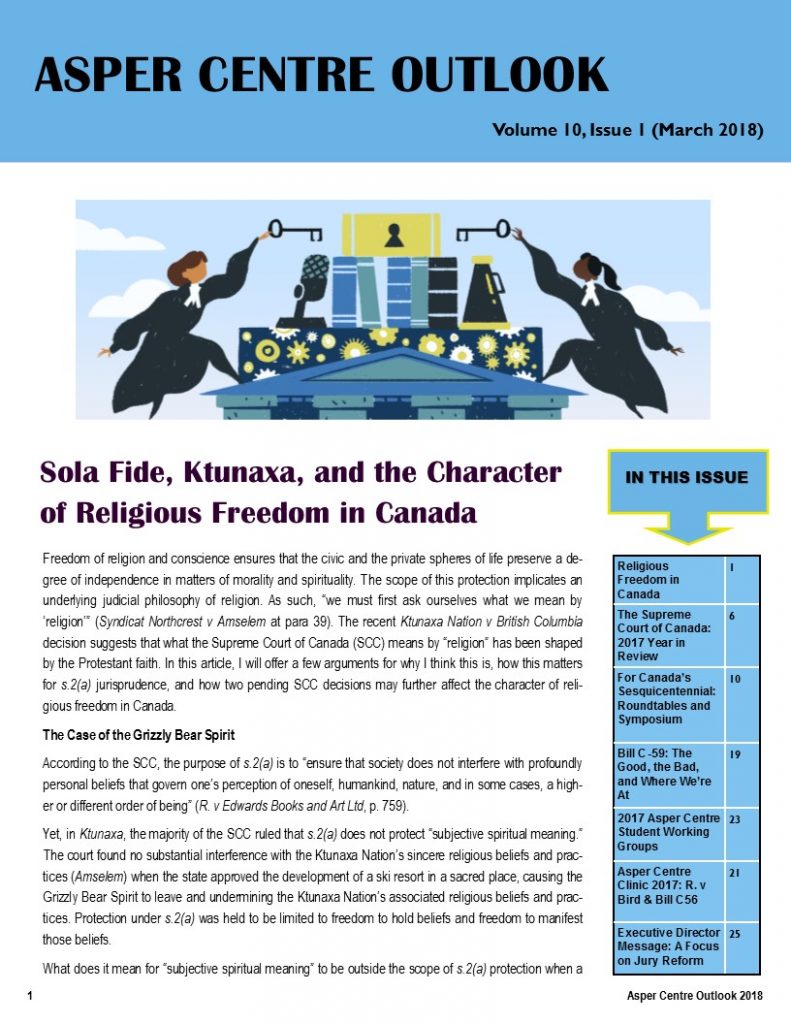
Click on the above image for online version.
PDF version available here.
by Becky Lockert
This past fall, the Supreme Court of Canada granted the Asper Centre leave to intervene in R v Bird, a case that ties questions of access to justice and constitutionalism to the doctrine of collateral attack. The question at the heart of the case is, from the Asper Centre’s perspective, whether a court applying the collateral attack doctrine must explicitly consider countervailing factors to ensure that administrative orders are Charter compliant.
Mr. Bird, the appellant, was labelled a long-term offender and, upon the completion of his prison sentence, was subject to certain supervisory conditions. Although he had requested that he be released into his First Nations community, the Parole Board ordered Mr. Bird to reside in a community correctional facility. Notably, this community correctional facility is the same one where he served the end of his prison sentence.
On a January evening two years ago, Mr. Bird left his assigned correctional facility and did not return. Police apprehended Mr. Bird several months later, leading to a charge of breaching a long-term supervision order and the threat of up to ten years in prison.
At trial, Mr. Bird successfully argued that the imposition of the residency condition was contrary to s. 7 of the Charter and outside the statutory authority of the Parole Board, because continued incarceration cannot be a condition imposed by a long-term supervision order. Allowing the appeal, the Saskatchewan Court of Appeal held that Mr. Bird was precluded from challenging the legality of the supervision order condition. To make such an attack, the Court of Appeal concluded, would be allowing a collateral attack and contrary to legislative intent.
The Supreme Court granted leave to intervene to the Asper Centre in September 2017. The intervention team, consisting of Cheryl Milne (Asper Centre Executive Director) , Breese Davis (the Asper Centre’s 2017-18 Constitutional Litigator-in-Residence), and five clinic students, had six weeks to prepare our intervenor factum. Our task was to craft an argument that the Court, when determining whether to bar a collateral attack, should consider both the constitutionality of the administrative order and access to justice.
Cheryl and Breese immediately gave the reins to our small group of students. Gaining familiarity with the subject-matter was our first step; we assigned out research and set off to produce memos. Meeting regularly and communicating constantly, the group narrowed our issues and determined our approach. We would advocate for adding two branches to the collateral attack framework (from the Supreme Court’s judgment in R v Consolidated Maybrun Mines Ltd.).
First: courts cannot be complicit in the enforcement of unconstitutional administrative orders by refusing collateral attack against them. This would be contrary to the rule of law and the principle of constitutionalism. Especially in this case, where Mr. Bird’s liberty interest is at stake, compliance with the Charter cannot be left out from the Court’s analysis.
Second: courts should take note of access to justice challenges that make judicial review of administrative orders essentially inaccessible. Charter protections cannot be rendered meaningless by an effective inability to challenge potentially unconstitutional conditions.
Having determined our strategy, the drafting process began. For a number of us, this was to be our first factum. Cheryl and Breese put great faith in the group to craft the Centre’s written argument, providing helpful (and at times, challenging) feedback to our work-in-progress. The ability to maximize on Cheryl’s expertise in drafting intervenors’ facta and Breese’s wealth of knowledge as a seasoned criminal defence lawyer was immeasurably helpful. There were a series of late nights at the Faculty, including line-by-line group editing sessions where we wrote and re-wrote sections of the factum.
Following a series of drafts, more line-by-line edits, and finally a submission to Cheryl and Breese, we had our finished product. A few final tweaks on their end, and the factum was submitted to the Court and out of our hands.
The prospect of the Supreme Court reading our writing is a daunting one for students – daunting, but exciting. The Court will be hearing oral submissions on the case this upcoming March, and many of our student group will be coming along to see our arguments in action. How will the Court approach our arguments? Is our position persuasive, and will the Court accept the position that access to justice and constitutionalism must be considered?
Having this opportunity to draft an intervenor factum has been invaluable for our student group. On a personal note, I can attest to this being the most meaningful and challenging part of my law school career thus far. Being surrounded by four other dedicated and bright law students and having guidance from highly skilled supervising lawyers has resulted in a piece of work and an experience that I am proud to have been a part of.
Becky Lockert is a 2L JD Candidate at the Faculty of Law and was a student in the Asper Centre Clinical Legal Education Course.
By Crystal Li and Juela Xhaferraj
On February 9, 2018, the University of Toronto Faculty of Law was host to hundreds of high school students who were attending the annual Global Citizenship Conference organized by Law in Action Within Schools (LAWS). Members of the Asper Centre’s Immigration and Refugee Law student working group were pleased to lead one of the workshops for the students at the Conference. Members of the Asper Centre’s other two student working groups (on Indigenous Rights and Police Oversight) as well as students from the International Human Rights Program at U of T Law, also led workshops at the Conference.
In keeping with the Global Citizenship Conference’s overarching theme, the Immigration and Refugee Law group’s workshop aim was to demonstrate to the student participants how global events have a local impact. We explored this theme through the lens of the Syrian refugee crisis. After a general introduction to the events that precipitated the refugee crisis and the conditions facing refugees, the rest of the presentation turned to the responses to the crisis. To provide a comparative perspective, we described Turkey and Germany’s responses before discussing the Canadian context. Part of the discussion on Canada’s response focused on the Safe Third Country Agreement (STCA) and why it might be necessary to suspend it. The STCA is a bilateral agreement between the United States and Canada that stipulates that asylum seekers must lodge a refugee claim in the country in which they first arrive and that, subject to some exceptions, Canada can refuse or bar someone from lodging a refugee claim and force their return to the United States.
The STCA discussion was also a means of introducing the students to the work of the Asper Centre and its students. This academic year, the Asper Centre’s Immigration and Refugee Law student working group provided legal research assistance to the public interest litigants (Amnesty International, Canadian Council of Churches and the Canadian Council of Refugees) who have joined an individual litigant challenging the constitutionality of the STCA. This challenge is argued on the basis that the United States should not be deemed a safe country for refugees given that the rights of refugees in the United States under the Trump administration have seriously plummeted and hence the STCA should be suspended at this time.
During the workshop, the participating students actively engaged in the discussions and exhibited an impressive understanding of the issues facing refugees both globally and locally. While some students were skeptical of Turkey’s and Germany’s true motives in accepting a large number of refugees, most agreed that Canada should learn from the two countries’ approaches and take in more refugees. In particular, the students saw the analogy between Germany’s now suspended Dublin Regulation (which regulates which country in Europe must examine a refugee claimant’s application at first instance) and Canada’s STCA with the U.S. Many of the students felt that the Canadian government’s refusal to suspend the STCA is inconsistent with the accepting and welcoming public image held up by the government.
Towards the end of the presentation, the students asked about the practice of immigration and refugee law and about the work of the Asper Centre. Many of them found it exciting that law students are able to work on important immigration and refugee law cases while still in law school.
Crystal Li and Juela Xhaferraj are both 1L JD Candidates at the Faculty of Law and are members of the Asper Centre’s Immigration and Refugee Law student working group this year.
John Norris, the Asper Centre’s former Constitutional Litigator-in-Residence in 2006 and Asper Centre Advisory Group member, who served as counsel for the Asper Centre in a number of our interventions, has been appointed a justice to the Federal Court of Canada.
A sole practitioner based in Toronto, he fills a new position created under An Act to amend the Immigration and Refugee Protection Act and the Federal Courts Act (S.C. 2010, c. 8). An established trial and appellate lawyer, in criminal, constitutional and national security law, Norris was appointed in 2008 to the roster of Special Advocates for security certificate proceedings under the Immigration and Refugee Protection Act, and acted as Special Advocate in a lengthy and complex security certificate proceeding before the Federal Court.
Deeply committed to legal education, Norris has also been an adjunct professor at the Faculty of Law since 1996, teaching criminal law, evidence, constitutional law, national security law, and legal ethics courses.
Read the full announcement here.
by Ryan Howes
On January 31, 2018, the Asper Centre Constitutional Roundtable Series hosted Athanasios (Akis) Psygkas, Lecturer in Law at University of Bristol and Visiting Scholar at the University of Toronto. His presentation was titled: “The hydraulics of constitutional claims: Four models of democratic constitutionalism and same-sex marriage.” Professor Brenda Cossman, Director of the Bonham Centre for Sexual Diversity Studies, joined as discussant.
There are many actors involved in constitutional interpretation. Psygkas identified a bottom-up process of constitutional evolution wherein multiple actors raise claims with constitutional implications. To articulate this “hydraulics” process, he conducted a case study of the legal recognition of same-sex marriage in four countries: the US, Spain, the UK, and Ireland.
In Obergefell v Hodges, the US Supreme Court held that the Fourteenth Amendment of the US Constitution requires state to issue marriage licenses to same-sex couples. The decision focused on liberty. Justice Kennedy, writing for the majority, provided a list of social actors (“central institutions in American life”) that contributed to the evolving debate of constitutional interpretation regarding same-sex marriage and argued that this debate had now reached a stage of deliberative maturity that permitted the Court to channel this into constitutional law.
In Spain, same-sex marriage was recognized through the legislature, beginning first at the regional level before being formalized in national legislation. In further contrast to the US, the petitions that were put forth in support of legalizing same-sex marriage focused on equality, not liberty. When challenged, the Spanish Constitutional Court stated that it cannot remain “aloof from social reality” and cited statistics concerning Spanish attitudes toward same-sex marriage in making its decision to recognize same-sex marriage.
In the UK, the process to recognize same-sex marriage was largely legislative and proceeded in stages. First, homosexual activity was decriminalized for persons over 21 years of age in 1967. But this provoked some backlash: legislation prohibiting promotion of homosexuality remained in place until 2003. Civil partnerships were created in 2004, which permitted homosexual couples legal recognition. Formal recognition of same-sex marriage came into effect in 2014. Throughout these stages, there was no electoral manifesto concerning same-sex marriage; rather, the process occurred organically through public consultations and hearings at the committee stage of the legislative process. The debate continues in Northern Ireland, where a married, English same-sex couple is challenging the state’s refusal to recognize their marriage.
The Republic of Ireland has direct citizen involvement in constitutional change through referendums, especially when change concerns fundamental laws, like constitutional amendments. The consensus in Ireland, however, had long been against recognizing same-sex marriage. This social attitude had influenced how politicians and the judiciary interpreted relevant legislation and articles of the Irish Constitution, especially Article 41, which concerns family. In 2013, a referendum on same-sex marriage was conducted and by a 62% approval vote brought the 34th Amendment of the Irish Constitution into existence, granting same-sex marriage legal recognition.
Each of these four examples demonstrate the varied systems and means through which social actors influence constitutional interpretation and change. The predominate direction of influence was bottom-up.
Professor Cossman argued that in Canada same-sex marriage recognition was a predominantly court-centric process, with Charter dialogue dominating the arguments. Parliament responded to Supreme Court of Canada (SCC) rulings by changing legislation. This process began with the SCC ruling that the common law definition of marriage as between one man and one woman violated section 15 of the Charter (Halpern v Canada). The Same-Sex Marriage Reference soon followed in 2004. This appears to be an exception to the hydraulics process that Psygkas observed in the four countries discussed. Although there were many activist groups active at this time, the Canadian experience of recognizing same-same marriage appears to have been more of a top-down process and did not exemplify the same hydraulics process Psygkas observed elsewhere. The SCC interpreted the Charter and Parliament followed. Invariably, some bottom-up processes were at play in the Canadian same-sex marriage debate: our Charter is young and reflects Canadian values, and our judges are, after all, from the citizenry.
Psygkas argued that the driving force in this “hydraulics” process is a bottom-up demand for a specific constitutional position within complex institutional structures; the exact form it takes varies depending on the constitution and the institutions present. What implications does this have for when we observe social backlashes or rising sentiments that we perceive to be moving our society in the wrong direction? Current political preoccupations with the so-called “populist” wave are perhaps an instance of this process.
Ryan Howes is a JD Candidate at the Faculty of Law and is the Asper Centre work-study student.