
Evaluating Ontario’s Proposed Police Legislation

By Sarah Strban


A (Slightly) Safer Ontario

On November 2nd, the Ontario Legislature tabled an omnibus bill that comprehensively overhauls the province’s police oversight system. Bill 175, The Safer Ontario Act, is intended to resolve many of the oversight issues raised by Justice Michael Tulloch in his April report. Among them, the Bill clarifies police responsibilities, formally defines oversight mandates, establishes a new complaints body, and moves adjudication externally. As a whole, Bill 175 is a valuable piece of legislation. That said, this new system still allows for police investigating police, and therefore perpetuates a main source of public distrust. The legislation has varying impact on different oversight bodies, which will be explored below.

Ontario Police Forces: Bill 175 does not significantly change the structure of Ontario police forces, nor their policing procedures. The Bill confirms police duties and responsibilities, and sets out the general rules for provincial and municipal forces. It also establishes formal whistle-blowing procedures and protects against internal reprisals. Where Bill 175 breaks ground, however, is in its formal acknowledgment of Indigenous issues. The Bill affirms the unique culture of Indigenous peoples in Canada, and acknowledges a history of conflict in Indigenous policing. Bill 175 also makes strides in its creation of the Inspector General of Policing. This new position will actively monitor police forces and police service boards, to ensure that they comply with the Police Services Act. In general, Bill 175 only makes modest changes to the Ontario police forces themselves, but these changes are important for forging relationships and increasing public confidence.

Criminal Misconduct: Bill 175 is most successful in its amendments to the Ontario criminal oversight system. The legislation expands the mandate of the Special Investigations Unit (SIU) and strengthens the oversight body’s investigatory powers. The SIU is now mandated to investigate 1) all instances of death, serious injury, and firearm discharges, and 2) any further criminal conduct that emerges in their investigation. It had not previously had jurisdiction over firearm discharges, nor could the SIU investigate other kinds of police criminal conduct, such as fraud or obstruction. Bill 175 also formally defines “serious injury” to include cases of sexual assault, which was a major recommendation in Justice Tulloch’s report. In addition, the new legislation strengthens SIU investigations through a duty to comply, and lays down requirements for more public transparency. Overall, the new legislation is successful at empowering the SIU and ensuring meaningful criminal oversight.

Ethical Misconduct: Where Bill 175 disappoints, however, is in the arena of disciplinary misconduct. The legislation makes important changes to Ontario’s oversight mandate, but fails to fully solve the problem of police investigating police. Currently, the Office of the Independent Police Review Director (OIPRD) sends the majority of public complaints back to the same police force to be investigated. Under Bill 175, the new Ontario Policing Complaints Agency (OPCA) can still refer its complaints back to the police, but only to a different police force than the one under investigation. While this is an important step for improving public confidence, this does not resolve the core issue of police investigating fellow police officers. Bill 175 therefore misses a key opportunity to reform police oversight, namely by ensuring independent investigations. Where Bill 175 does succeed, is by expanding OPCA jurisdiction to include special constables’ and First Nations’ police misconduct. The Bill also imposes a duty to cooperate with investigations, so it increases oversight reach and competence in this regard. Overall, the new legislation makes important changes to police oversight, but does not go far enough in ensuring independent investigations.

Discipline Adjudication: Perhaps the greatest success of Bill 175, is the complete overhaul of Ontario’s police adjudication system. Before, police complaints were adjudicated internally by fellow officers, with only appeals heard before an independent tribunal. Now, all instances of police misconduct will be heard before the new Ontario Police Discipline Tribunal, with appeals going to Divisional Court. This means that all police adjudication will be formal, public, and competent. This is a significant change to Ontario’s police oversight procedures, and will be essential for generating public confidence in the police.

Overall, Bill 175 is a much-needed, well-timed amendment to Ontario’s police oversight system. The Bill is not perfect by any means, but it takes major steps towards proper accountability, transparency, and trust in Ontario policing.

Sarah Strban is a 2L JD Candidate at the Faculty of Law. She is the current co-leader of our Police Oversight student working group and she held an Asper Centre Summer Fellowship in 2017 focused on researching police oversight systems in Canada.
Constitutional Roundtable Recap

By Ryan Howes


Alistair Price on “The Relationship between Constitutional and Tort Damages for State Failures to Protect in Canada, England, and South Africa”

On November 29, 2017, the Asper Centre Constitutional Roundtable hosted Alistair Price, Associate Professor in Law, University of Cape Town. Price’s presentation was titled “The Relationship between Constitutional and Tort Damages for State Failures to Protect in Canada, England, and South Africa.” Richard Stacey, Assistant Professor, University of Toronto Faculty of Law was the discussant.

What is the appropriate legal approach to damages caused by public officials failing to meet their state-mandated positive duties?  Public law compensation often grants little or no monetary remedy for damages when it is available at all.  Tort is a more viable legal recourse for adequate monetary remedy. However, the standard for tort liability vis-à-vis public officials differs in Canada, England, and South Africa.  Each has adapted a unique approach in adopting tort law to the context of public wrongs.

On the conservative pole of the spectrum, English law has preserved the traditional torts approach. There is no positive legal obligation in tort required of public officials beyond that which is also ascribed to a private citizen. As defendants in tort, English law applies the same standard to public officials and private citizens.

South Africa is positioned at the opposing pole of this spectrum. Public officials are obliged to adequately perform their public duties. They are liable for damages flowing from omission or negligent performance of their ascribed positive responsibilities. Public officials are distinct from private citizens, held to a higher standard.

Canada has taken a middle approach. Price argues that this evades the excesses of the South African approach and the deficiencies of the English approach.

In South Africa, the basic relational structure of tort liability has been altered in adapting the legal system to address public wrongs. In England, this relational structure is persevered but the legal system fails to recognize that public officials occupy a status of categorical superiority relative to private citizens by virtue of their position. Applying the traditional private law approach of basic equality between the parties fails to recognize the judicial inequality that exists between the parties in the context of public damages.

In Canada, failure to perform positive public duties is actionable in tort law, but the basic relational structure still exists. The public official’s duty must have been a duty to this plaintiff at the material time. This often manifests in the context of policing. The Jane Doe v Metropolitan Toronto (Municipality) Commissioners of Police case is one such instance.

In commenting on Price’s paper and presentation, Richard Stacey offered a different perspective, one more favourable to the South African approach. Whereas Price finds laudable moderation in the Canadian approach, Stacey adopts a more categorical perspective wherein Canada is straddling the distinct paradigms embodied by England and South Africa. Canada is in a state of transition, moving toward the South African approach.

Stacey likened the current Canadian position to the geocentric model before the paradigm shift to a heliocentric model. Anomalies amass. Sub-theories grow in number to keep the theoretical framework coherent until the threshold is met and a paradigm shift occurs.

The paradigm shift is from merely applying traditional tort principles to adopting public law solutions for damages caused by public officials failing to fulfill their positive duties. The dissent and majority judgements in the Paradis Honey Ltd v Canada (Minister of Agriculture and Afri-Foods case represent the debate between these approaches within the context of Canadian law.

What accounts for these differences? Price posits that the constitutional culture of each country plays a role.

The constitutional culture in South Africa is deliberately transformative. The constitution is perceived as an instrument for social change. Damages from public negligence is just one more domain to which it is applied. By contrast, English constitutional culture is more conservative in bent.

Canadian constitutional culture contains elements of both, each contributing to the fertile soil of our living tree. How a disbalance will affect its continued development remains to be seen.

Ryan Howes is a 1L JD Candidate at the Faculty of Law and is currently the Asper Centre’s work-study student

Recapping the Panel Discussion on the upcoming Trinity Western University Appeals

by Ryan Howes

On November 30 and December 1, the Supreme Court of Canada (SCC) will hear arguments in the Trinity Western University (TWU) appeals. The question: Can the law societies of Ontario and British Columbia refuse to accredit graduates of the TWU’s proposed law school?

The point of contention in this case is TWU’s community covenant, which requires all staff and students to abide by biblical morality and abstain from sexual behaviour outside of heterosexual marriage. The resulting discrimination on the basis of sexual orientation is the basis for the law societies’ refusal to accredit TWU.

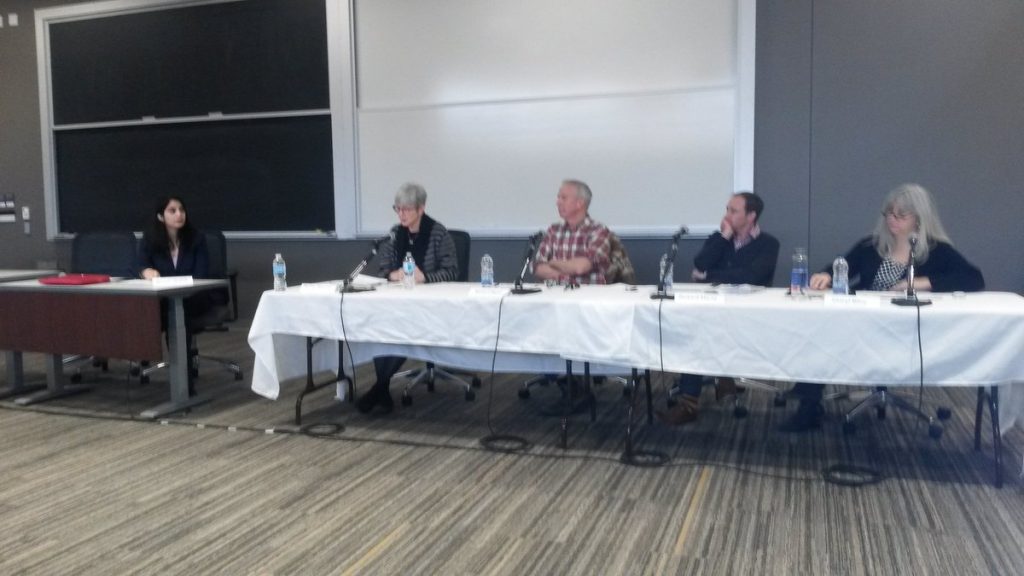
Along with Out in Law and the Journal of Law & Equality, the Asper Centre co-hosted a panel discussion last week to unpack the issues in the upcoming TWU appeals. The panelists were Professors Denise Réaume and Richard Stacey from the University of Toronto Faculty of Law, Professor Richard Moon from the University of Windsor Faculty of Law, and the Asper Centre’s Executive Director Cheryl Milne.

Though the panelists did not divulge any predictions on how the SCC would rule, each discussed the case from a different perspective.

Richard Stacey discussed the mandates of the law societies and their roles as administrative decision makers. TWU claims the law societies are going beyond their mandate in refusing to accredit them. Indeed, Professor Stacey pointed out that TWU graduates would likely qualify for accreditation on the merits of the proposed law school’s curriculum.

Public interest concerns are central to the law societies’ arguments. TWU argues that there is no evidence of harm to the public interest and the law societies should not be regulating the religious behavior of its students.

A question from the audience concerned whether the SCC can avoid establishing a hierarchy of rights in this decision, something the SCC has long rejected. How are equality rights and freedom of religion to be balanced?

Richard Moon commented on how he disagreed with the “balancing of rights” characterization of the cases. The issue is space, not values. Should religious communities composed of willful participants have the space to govern their internal affairs by their own moral standards?

Denise Réaume argued that the Charter is less sophisticated in negotiating rights of equal treatment and the rights of others than the Ontario Human Rights Code. The Code (s.18) permits special interest organizations (including religious and educational institutions) to restrict membership to persons of similar identity. Human rights decisions, in her view, have been better at negotiating the boundaries of the competing rights claims, than what has transpired under the Charter.

The granting of exclusive space is limited to private and internal affairs. The Law Society of Ontario argues that the TWU community covenant has a negative external impact, arbitrarily limiting access to the legal profession on the basis of sexual behavior preferences.  Furthermore, discriminatory admissions criteria compromise merit based admissions.

The community covenant only pertains to behavior. TWU welcomes LGBTQ students, so long as they are willing to sign and abide by the community covenant. It defines acceptable behavior, not identity per se. To what extent are behavior and identity really so separable?

Cheryl Milne discussed the procedural idiosyncrasies of the TWU appeals in relation to the treatment of the interveners.  Many LGBTQ advocacy groups applied for intervener status. Initially, none were accepted. The social media response motivated the Chief Justice and Justice Wagner to reconsider the involvement of the interveners. The resulting second order of the Chief Justice was unprecedented. The Court announced in a news release that it had reconsidered the scheduling of the appeal and a second day of hearings would be added. All interveners who applied and were previously rejected would now be heard. A total of 30.

Motions are usually final. The SCC does not usually give reasons for its selection of which interveners get in and which do not. And, the announcement was followed by a media interview. The social media reaction was cited as a reason for the court’s decision. Very unusual.

The quantity of interveners is also unusual. Milne questioned the value of having 30 interveners. Is the 26th given the same attention as the 3rd?

The TWU appeals have already set SCC procedural precedent. It remains to be seen what precedent the decision will set.

Ryan Howes is a 1L JD Candidate at the Faculty of Law and is also the current Asper Centre work-study student

Ktunaxa Nation: A Lost Opportunity

By Patrick Enright


Indigenous Religion and the Court: A Lost Opportunity to Revise Religious Freedom Under the Charter

Earlier this month, the Supreme Court of Canada delivered its much awaited freedom of religion decision in the case of Ktunaxa Nation Council v British Columbia. Put simply, we could have waited longer. The decision marks a lost opportunity for the Court to have revised its freedom of religion jurisprudence, and is an extraordinarily dismissive analysis for what stands as the first indigenous religion brought under the Charter.

The Ktunaxa Nation Council, the appellants in the case, challenged the BC government’s approval of a ski resort on what is believed to be their sacred territory called “Qat’muk.” It was alleged that, should any construction go forward on the land, the Ktunaxa’s religious rituals would be deprived of any spiritual significance, as the “Great Grizzly Spirit,” who infuses their traditions with meaning, would permanently flee the territory. The case therefore raised the novel issue of whether s 2(a) of the Charter covers so-called “sacred sites,” and if there is any role for government in preserving the spiritual traditions of religious practitioners.

The Court, however, side-stepped all of the difficult questions of the case to simply (and tersely) assert that s 2(a) does not protect the “object” of religious beliefs. As such, it does not protect the (believed) existence of Grizzly Bear Spirt. Full Stop.

On the fascinating question of whether religious practices are intimately connected to religious beliefs themselves? Nothing.

On the issue of whether the recent origin of a religious claim can affect the proportionality analysis on judicial review? Nothing.

On the matter of whether preserving a religious community is more pressing than an individual’s religious belief? Nothing.

On whether the building of a ski resort is a sufficiently pressing objective to override a constitutional right? Nothing.

Instead we were subjected to a mere four paragraphs of analysis, with the Court merely affirming that s 2(a) only covers “beliefs” and the “manifestation” of beliefs, rather than the beliefs themselves.

But this is a senseless distinction. For the Ktunaxa, the manifestation of their beliefs requires that Qat’muk remain undisturbed. There would simply be no point in practicing their faith if the spirit that animates these practices no longer is present. By way of analogy, imagine attending a Christian Mass with the knowledge that Yahweh is no longer listening, or that God has taken a sick day to watch football. There would, alas, be no point in attending such an empty ritual.

Similarly, for the Ktunaxa, their god has been effectively killed by the State’s action in this case; or, as one twitter user suggested, “Nietzsche would have been proud of this decision.”

By this, I do not mean to say that the Ktunaxa should have come out victorious on their appeal – indeed, I think the case was deeply problematic on the facts. But failing to at least find an infringement is to fail to grapple seriously with the intimate connection that indigenous peoples and indigenous religion has with land and land claims.

Only the concurring opinion seems to have understood this. Justice Moldaver’s concurring opinion – in contrast to the majority – is a deeply satisfying, cogent analysis that takes seriously the novelty and gravity of the Ktunaxa’s religious claims. Justice Moldaver’s opinion makes the rather obvious point that manifesting the Ktunaxa’s religious beliefs required that Qat’muk go undisturbed; that indigenous religion requires the preservation of sacred sites; that not all religious beliefs can be framed in terms of protestant religious practices; that the impact on the Ktunaxa’s beliefs is severe; and, ultimately, that the state’s objective in fostering a prosperous tourism market in the province is sufficiently important to uphold the Minister’s proposal.

This analysis is thoughtful. It is sound. And it is just.

As for the majority, the Court could have saved itself 115 unnecessary paragraphs, and hundreds of wasted sentences, by simply stamping the following two words onto their jurisprudential writ:

“Appeal Dismissed.”

Patrick Enright  is a 3L JD Candidate at the University of Toronto and a former Asper Centre Clinic student.

Ktunaxa case summary and further information available on the Supreme Court of Canada’s website here. For further reading on this case, please see University of Toronto Faculty of Law Professor Anna Su’s commentary: A Tale of Two Burdens and Patrick Enright’s previous summary of the Ktunaxa case in our 2017 Asper Centre Outlook Newsletter at page 12.

Unpacking the Issues in the Upcoming TWU Appeals at the Supreme Court of Canada

by Tal Schreier

On November 30th and December 1st 2017, the Supreme Court of Canada will hear two appeals involving Trinity Western University (TWU), a private Christian university in British Columbia wishing to open a new law school. The appeals involve legal challenges to decisions by the law societies of British Columbia and Ontario and the impact of a policy that requires TWU students to sign a code of conduct forbidding sexual intimacy outside heterosexual marriage. Ontario decided to deny the accreditation of TWU law graduates in the future, while BC approved accreditation. The cases are expected to “break new constitutional ground” around how administrative decision-makers are to balance the competing Charter rights of equality and freedom of religion.

The David Asper Centre for Constitutional Rights is involved in three upcoming events at the University of Toronto’s Faculty of Law aimed at assisting students and the public in better understanding the key issues that are involved in the TWU cases. The Asper Centre  is jointly convening these events with Out in Law and the Journal of Law and Equality.

First, on November 23rd, ahead of the actual court dates, a Dean’s Emerging Issues Workshop Series panel discussion has been convened to consider and analyse some of the main issues that will be covered in the TWU appeals. The discussion will cover the administrative law issues involved, the balancing of competing rights and the unique circumstances regarding the involvement of public interest interveners in these cases. The panelists will include Professors Denise Reaume and Richard Stacey of the Faculty of Law, University of Toronto, Professor Richard Moon of the Faculty of Law, University of Windsor and Cheryl Milne, the Executive Director of the David Asper Centre for Constitutional Rights. Maryam Shahid, JD Candidate at the Faculty of Law and co-Editor of the Journal of Law and Equality will moderate the panel.

Second, on the actual hearing dates (Nov 30 and Dec 1) we have organized for the live-stream viewing of the arguments taking place at the Supreme Court of Canada. While the arguments are being live-streamed directly from the court, faculty members from the law school will provide commentary explaining the key issues as they arise. A schedule of “live-commentators” will be made available in due course.

Lastly, following the hearing, we will convene a post-TWU debriefing panel discussion. This presentation will provide an opportunity for some of the intervening parties’ counsel to discuss what transpired in the cases and what they may have liked to say to the court to better enrich the parties’ arguments, if not for the constraints involved. The date for this presentation will take place sometime in late January or early February of 2018.