
Skip to content

Immigration Detention Symposium: Responding to the IRB’s External Audit


by Olivia Martin and Adrian Ling

The first session of the Asper Center’s Immigration Detention Symposium, held on March 15, 2019 at the University of Toronto Faculty of Law, featured a panel discussing the 2018 Immigration and Refugee Board’s (IRB) External Audit report on Immigration Detention. Kathy Laird, a Toronto lawyer and author of the report, audited 312 immigration detention hearings for 20 different files selected on a random basis. She opened the panel by explaining that her task in completing the audit was to review the fairness of the process in order to ensure that the results of these detention hearings matched the evidence that was produced.

Laird candidly shared she was “shocked” by what she found when listening to the hearings and elaborated that some key themes were inconsistent and inaccurate factual findings and changing adjudicators within a single file. She shared one particularly impactful example of an individual who, in a single hearing, had his release plan turned down because it did not include drug counselling; it was in an urban setting, and it was too close to family where the last issue had occurred. However, in a subsequent hearing with a different adjudicator, a second release plan for the same individual was also turned down because it included unnecessary drug counselling, it was in a rural setting, and it was too far from family.

Aviva Basman and Nancy Weisman presented after Laird. Both were from the Immigration Division of the IRB, where Basman is Assistant Deputy Chairperson and Weisman is Senior Counsel.  As it turns out, the IRB began formulating a new set of detention policy guidelines in response to the problems found in Laird’s Audit. Additionally, between the time of the report and now, the Board had already begun implementing procedures in an effort to improve the system. Basman described a number of these changes, while Weisman spent the majority of her time outlining some of the new policies that were to be implemented in the guidelines.

Some of the changes Basman described related to the continuity of expertise in a detainee’s file. These included ensuring the same member of the Board (who would roughly fill the role of a judge in these decisions) would preside over each of a detainee’s hearings and making sure that the detainees’ bondspeople were being interviewed by members directly. It was surprising to us that this was not already the case, as it seems like the most intuitive way for these hearings to occur. Additionally, Basman was happy to announce that the new cohort of Board members recently hired all had experience in immigration and refugee law or detention work.

Weisman announced that the IRB’s detention guidelines would be published by the following Monday and highlighted some of its most significant shifts. The new policy de-emphasizes some of the categorical approaches that had been used before. For example, a lack of family ties to Canada is no longer dispositive of a person being a flight risk. Additionally, the new guidelines mandate a Stinchcombe-like breadth of ministerial disclosure and an active consideration of all possible alternatives to detention.

Hanna Gros, from the International Human Rights Program at the University of Toronto, emphasized that immigration detainees are held on administrative grounds, not criminal grounds. She highlighted that immigration detention is not a punishment, despite the fact that nearly a third of detainees were held in corrections centres last year, and immigration detainees are generally detained for reasons completely unrelated to public safety, most often including issues of unclear identity or potential flight risk.

Sarah Boyd, an associate at Jackman and Associates who works directly with detainees, spent time discussing what a procedurally fair detention hearing might look like. Boyd passionately emphasized that a procedurally fair detention hearing would look like any other procedurally fair hearing, featuring two parties coming to the table with the same information and being treated equally by the tribunal. However, from Boyd’s point of view, there are barriers that currently make many detention hearings less than fair for detainees, including the different standards that the detainee’s counsel and the CBSA officers are held to. While the detainee’s counsel is standing at the metal detector removing staples from paperwork as required, the CBSA officer is often in the hearing room chatting about their weekend with the Board member presiding over the hearing.

Despite their criticism, both Gros and Boyd expressed optimism that the IRB’s new detention guidelines would address a number of the concerns they discussed in the panel, with Gros noting that the guidelines are “crucial first steps in the right direction, but not the ultimate solution.”

Overall, the group shared a consensus that there is still need for further improvement and that the required change requires a concerted effort from all the stakeholders involved.

View a recording of the panel here.

Access the RESOURCES from the Immigration Detention Symposium here.

Olivia Martin and Adrian Ling are 1L JD Candidates at the Faculty of Law and members of the Asper Centre Immigration and Refugee Law student working group. 
 

Legal Aid Cuts: Devastating and Short-sighted


by Cheryl Milne

Devastating and short-sighted. These are the words that immediately come to mind in response to last week’s announcement that the Legal Aid Ontario budget would be cut by approximately 30% starting with the immediate end to funding for legal services to refugee claimants and immigrants.

To be clear, these are not cuts to lawyers, they are cuts to access to justice for some of the most vulnerable and neediest in our province. Attorney General Caroline Mulroney attempted to justify some of the cuts by citing a statistic that the number of people served by Legal Aid Ontario has dropped 10% over the past several years. But it should be clear to all that this is misleading. The income cut-offs for eligibility for legal aid funding has consistently fallen behind the cost of living so that fewer and fewer people qualify for legal aid funding. Further, any attempt to evaluate the benefit of legal aid must use more sophisticated methods than simply counting heads. As has been noted by other commentators, funding taken away from legal aid leads to increases in other government expenditures, including the costs of increased inefficiency in our justice system, as well as the devastating human toll of homelessness, family breakdowns and unjust incarceration.

Will these cuts infringe constitutional rights? The Charter and Supreme Court decisions have established the right to state funded counsel within the context of criminal prosecutions and state intrusion in the family through the removal of children in child protection proceedings. Legal Aid funding has generally provided the resources when it is clear the individual is unable to pay. But many in the system would say that it has done so inadequately. Child protection counsel decry the small amounts of time allocated by Legal Aid Ontario to representation of families caught up in the child welfare system. Indeed, to maintain the requisite professional competence in representing clients in this area, lawyers routinely spend unpaid hours working on these files. Similarly, the criminal defence bar has long advocated for more realistic funding for criminal files, with many lawyers reducing the number of legal aid cases they take on because of the simple need to earn a living. These cuts threaten the ability of the government to live up to its constitutional obligations while potentially decimating the funding for other critical areas of legal representation for the poor and vulnerable in Ontario.

The most devastating immediate impact is the end to legal aid for immigrants and refugee claimants without warning. Clearly, the provincial government sees this as a political football that it is kicking to the federal government because, “of course”, they are the cause of the immigration crisis in the province. In fact, there is no crisis and to characterize this as wholly a federal responsibility fails to understand the impact of immigration, more frequently positive than negative, on the province as a whole. Will this lead to constitutional arguments under section 7 of the Charter in favour of funded legal services? Perhaps. It might end up being that the federal Department of Justice must pay, but to leave people stranded without representation without warning and without consultation is both heartless and bad policy. People will be deported to face persecution, torture and possibly death. Individuals will languish in immigration detention without proper representation in a detention review system that continues to be in need of serious overhaul. And that is on all of us.

We cannot choose to be citizens of the Province of Ontario and not citizens of Canada when it suits. We are all responsible for this and need to hold our representatives accountable for what the aftermath of these cuts will be for everyone.

Cheryl Milne is the Executive Director of the Asper Centre

Asper Centre students call for Canada to suspend STCA on Refugee Rights Day

via @UTLaw: https://www.law.utoronto.ca/news/students-call-on-canada

Thursday, April 4, 2019

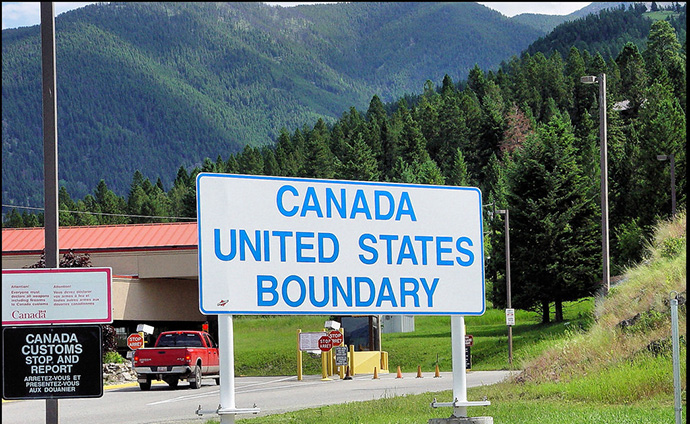
Image of Canadian border sign

By Karen Chen and Mackenzie Claggett

Canada presents itself to the world as a place where “those fleeing persecution, terror and war” are welcome. It is a reputation that Prime Minister Justin Trudeau touted on Twitter following the decision in the U.S. to institute a travel ban against several Muslim-majority countries and refugees. It is a reputation the Supreme Court affirmed when it released its Singhdecision 34 years ago on this day, April 4, finding that the constitutional right to life, liberty and security of a person extends to those seeking refuge in this country. It is a reputation we must uphold.

As law students engaged in refugee advocacy at the University of Toronto’s Asper Centre for Constitutional Rights, on this Refugee Rights Day, we call on the government to suspend or terminate the Safe Third Country Agreement (STCA).

Under the agreement, asylum seekers who attempt to enter Canada from the United States at border ports of entry are turned away and forced to seek protection under the American system.

This means that while Canada’s internal laws and policies may reflect our commitment to refugee rights, we are complicit with America’s asylum system under the Trump administration.

This will be especially true if the government decides to expand the agreement to cover all asylum-seekers to Canada, who were previously in the U.S. It was reported this week that Canada and the US have moved towards doing so.

By continuing the STCA, the Canadian government forces asylum seekers to choose ever more dangerous and clandestine routes of entry.

On Refugee Rights Day, let us remember the choices Canada has made as a country that respects the rights of those fleeing violence. After 157,000 displaced persons immigrated to Canada following the Second World War, Canada signed the 1951 Refugee Convention to recognize its willingness to take in refugees. In the 1980s, Canada developed a world-renowned private-sponsorship program to assist thousands of Vietnamese, Cambodian, and Laotian refugees find secure settlement. Over the past decade, Canadians have aided more than 40,000 Syrian refugees with this program. This past December, the Canadian government signed the United Nations Global Compact for Safe, Orderly, and Regular Migration. The compact provides a non-binding framework for governments to develop human-rights based migration policies, including objectives to reducing vulnerabilities in migration, strengthening certainty in migration procedures, and empowering migrants to achieve social cohesion.

Being part of the STCA means American refugee policy becomes Canadian policy. When the STCA came into effect in 2004, the underlying rationale was that both countries offer “generous systems of refugee protection” and therefore are safe for asylum seekers.

Much has changed since then.

Since the start of the Trump Administration, there is ample evidence to suggest that “safe” is a mischaracterization of the American asylum system. The family separation policy is one example of this. In November 2018, the Trump administration attempted to deny refugee protection to all claimants who did not enter the United States through a formal port of entry. This rule contradicts Article 31 of the Refugee Convention which imposes an obligation that countries not punish asylum seekers for the manner in which they enter the country. While two Guatemalan children died in immigration custody, the Trump administration announced in December 2018 it would force asylum seekers at the southern American border to remain in Mexico until their court hearing. The result has been a humanitarian crisis that puts the health and safety of asylum seekers at risk due to the lack of support services available to provide housing, medical care, and other necessities. By February 2019, President Trump used this government-manufactured crisis as the basis for declaring a “national emergency” to secure additional funds and build a barrier on the southern border.

Although we recognize the benefit of international cooperation when it comes to processing asylum seekers, such benefit no longer exists if our cooperation is with a country that does not adhere to international refugee law or the ideals Canada espouses with respect to refugee rights. The Canadian government must recognize the harm the STCA is currently imposing on asylum seekers and act accordingly.

Karen Chen is a second-year student at the Faculty of Law where she leads the Asper Centre’s Refugee and Immigration Law student working group. She is also a member of the Canadian Association of Refugee Lawyers.

Mackenzie Claggett is a first-year student at the Faculty of Law and is a member of the Asper Centre’s Refugee and Immigration Law student working group.

https://www.law.utoronto.ca/news/students-call-on-canada


Choose Your Battleground: Recapping the Beaver v Hill Panel Discussion


by Hannah Goddard-Rebstein and Arjun Gandhi

On Thursday, March 21st, the Asper Centre held a panel on Indigenous rights and family law, using the case of Beaver v Hill as a focal point for the discussion. The panel was convened by the Asper Centre’s Indigenous Rights student working group.  Professor Carol Rogerson moderated the discussion, and Joanna Radbord (Martha McCarthy & Co., and counsel to Ms Beaver), Jessica Orkin (Goldblatt Partners), Judith Rae (Olthuis Kleer Townshend) and Professor Kerry Wilkins participated as panellists. It is important to make it clear from the outset that no panellists were Haudenousaunee, meaning that discussion of Haudenosaunee law comes from their experiences working as lawyers and second hand knowledge.

Brittany Beaver and Ken Hill are Haudenosaunee parents to a nine-year-old son who have been litigating over the child support Mr. Hill must pay for several years. Mr. Hill, a very wealthy businessman, claims he has a constitutional right to have their family law dispute decided according to Haudenosaunee laws. His application was dismissed at trial, but in October 2018, the Ontario Court of Appeal granted him leave to pursue his constitutional claim.

Ms. Radbord began the discussion by bringing in the perspective of Ms. Beaver, whose personal experience is important to consider first and foremost. Ms. Radbord argued that the Ontario Court of Appeal (ONCA) decision effected an erasure of the lived reality of Indigenous women and children. She thought that focus on the best interests of the child involved had been lost, pointing out that the parties negotiated for two years under Ontario law before this claim was brought up, and it has the effect of making all orders Ms. Beaver receives interim as the constitutional case moves slowly through the court system. In addition, the court disregarded the collective interests of Six Nations people by allowing an unauthorized individual seeking to avoid child support guidelines, when this is a vital constitutional issue that demands that all governments be at the table, engaged in negotiation.

The panellists agreed that the facts of this case were not an ideal way to pursue an Aboriginal rights claim. Ms. Rae emphasized that something coming forward as a surprise at an individual level with no government or authority taking part is nobody’s ideal strategy, but it is something which can’t necessarily be prevented from happening. Ms. Orkin mentioned that Hill’s lack of involvement in the traditional community he is invoking matters strategically (both from the perspective of whether a court will view it positively and as an evidentiary concern). In addition, she pointed out that to suggest that his goals are to forward recognition of Indigenous rights is belied by what we can see on the record. Prof. Wilkins brought up that judges have taken a very jaundiced view of Mr. Hill’s presentation and are likely to be concerned that acknowledging the relevance of Haudenosaunee law here is giving him a get out of jail free card, meaning that this case has a chance of poisoning the ground in terms of recognition and enforcement of Indigenous law.

However, panellists also pointed out that Mr. Hill’s level of involvement in his community does not determine his claim. Ms. Orkin argued that the question which matters, if there is law that a court would recognize, is whether he is subject to that law, not whether he is active in his community; and that this is a question for the Six Nations community. Ms. Rae added that this is not about ethnic or cultural First Nations identity, it is a matter of political citizenship. How First Nations citizenship works is currently highly contested, and may start to mean more and come with more power and obligation going forwards. In addition, Ms. Rae pointed out that his status as an individual without collective backing does not mean he cannot raise an Aboriginal rights argument: as a fundamental principle, individuals who have rights should be able to raise them in certain circumstances.

Ms Rae argued that our current legal framework for determining Aboriginal rights generally, and especially in the context of self-governance issues is atrocious, as shown by the unreasonable requirements of the Van der Peet test. She pointed out that one contributing factor to this problem has been cases coming up through individuals. For example the Van der Peet test was first applied to harvesting rights, and then imported to self governance through Pamajewon, which dealt with bingo games on reserve. That case had the effect of closing the door firmly on self-governance issues through the courts, due to the bad facts and difficulty of providing evidence about regulating specifically “gambling” from pre-contact times. The risk with Beaver v Hill is that a negative outcome would similarly hold back other claims.

Several panellists also pointed out that Mr. Hill faces an evidentiary barrier in making his case. Ms. Orkin expressed doubts that the case would have the evidence needed, given that when she worked with the Haudenosaunee Confederacy, chiefs did not go to court, and took a position on the jurisdiction of Canadian law that is not cognizable to the courts. Prof. Wilkins added that the Haudenosaunee understand themselves to be sovereign, and take the position that Canadian law has no application to them. Ms. Rae pointed out that as the relevant parties have not come to court, we do not know what Haudenosaunee law is.

Overall, the panellists agreed that the facts of this case were troubling, both in respect of the situation in which it places Ms. Beaver and its broader legal implications. While lack of involvement in his community or standing as an individual are not fatal to Mr. Hill’s case, the evidence needed to make out the claim does not seem to be present. However, the positive takeaway emphasized by Prof. Wilkins was that the ONCA decision leaves the door open to a properly framed claim to self-governance rights.

Hannah Goddard-Rebstein and Arjun Gandhi are both 1L JD Candidates at the Faculty of Law and are members of the Asper Centre’s Indigenous Rights student working group this academic year.

Trial by military: Spotlight on R v Beaudry

by Teodora Pasca

Years ago, Corporal R. P. Beaudry was charged with sexual assault causing bodily harm, an offence under s 272 of the Criminal Code carrying a maximum penalty of 14 years’ imprisonment. Beaudry, a member of the Canadian Armed Forces, requested a jury trial. And because he was a member of the Forces, his request was denied.   

Until recently, criminal offences committed by military officials were understood to fall under the enumerated exception in s 11(f) of the Charter, which provides that any accused person has the right to trial by jury, “except in the case of an offence under military law tried before a military tribunal.”  But in September of 2018, the Court Martial Appeal Court of Canada (“CMAC”) held that trying Beaudry’s case by court-martial was unconstitutional under s 11(f) of the Charter, because it denied him the right to a jury trial for serious Criminal Code offence that is not an offence under military law.  

The Beaudry decision effectively froze the Forces’ ability to prosecute serious criminal offences within the bounds of their own justice system and threw dozens of ongoing military prosecutions into a state of uncertainty.  

On March 26, 2019, the Supreme Court of Canada (SCC) is scheduled to hear a Crown appeal from CMAC’s decision. The SCC’s decision on the constitutionality of military prosecutions for serious crimes will have significant ramifications for how military officials are prosecuted going forward.  

Background and the CMAC decision 

Beaudry, and all other members of the Forces accused of criminal offences, are subject to s 130 of the National Defence Act (“NDA”), which is contained within the statute’s Code of Service Discipline. Section 130(1)(a) classifies nearly all offences under the Criminal Code and any other Act of Parliament as “service offences,” bringing them within the jurisdiction of military courts.   

Before the CMAC ruling in Beaudry, the NDA authorized courts-martial to try all service offences committed by members of the Forces (except murder, manslaughter, and offences related to child abduction)Accordingly, s 130 of the NDA ropes nearly all criminal offences committed by military officials into a system of justice completely separate from civilian courts.

In a 2-1 decision, CMAC held that s 130(1)(a) violated s 11(f) and could not be justified under s 1 of the CharterCMAC held that “service offences” under s 130(1)(a), including Criminal Code offences, are not equivalent to “offences under military law” referred to in the exception in s 11(f) — which refers not to general crimes like sexual assault, but rather to offences that specifically violate military orderFurthermore, while military prosecutions may align with the objective of maintaining discipline and order within the Forces, that objective does not justify denying members of the Forces the right to trial by jury.  At para 49, a majority of the court stated that “it would be ironic for those who have the ultimate responsibility of protecting freedom, justice and social equality, at the risk of their lives, to not enjoy these same rights.”  

Issues before the SCC 

The immediate effect of the CMAC ruling was to disrupt three ongoing sexual assault prosecutions within the military justice systemOfficials warned that its further effect would be to toss 40 serious criminal cases — including 22 alleged sexual assaults — to already overburdened civilian courts, eliminating the Canadian Forces’ ability to ensure that those offences were prosecuted 

But in January 2019, the SCC denied an application to stay CMAC’s declaration of invalidity, leaving the Forces unable to prosecute offences attracting the right to trial by jury until the SCC’s final ruling on the matter in March.   

The SCC’s decision in Beaudry will chart a course for the future of military prosecutions of serious crimes. The Court will need to consider the scope of the exception to trial by jury for offences “under military law in s 11(f), as well as whether any infringements can be justified in light of the military justice system’s long-term goals.  

The Court will also likely engage with concerns about horizontal stare decisis, which informs when appellate courts may depart from their own decisions. Prior to its ruling in BeaudryCMAC previously found no infringement of s 11(f) on the same provisions of the NDA in R v Royes, and subsequently in R v DéryYet apprehension from the court Déry, albeit in obiter, led CMAC in Beaudry to conclude that the law on this issue remained uncertain.  

Advocates for the Rule of Law, interveners on the SCC appeal, argue that adherence to precedent is a key part of the rule of law, a fundamental constitutional principle. The SCC has previously dismissed a challenge to s 130(1)(a) of the NDA under s 7 of the Charter, but has not yet ruled on the provision’s constitutionality in the context of the right to a jury.  

Significance of the Beaudry case 

By virtue of its controversial nature, the Beaudry case has made national headlines and thereby increased public exposure to the military justice systemThe SCC’s incoming decision on this matter may push us to consider the utility of having a separate system of prosecution for military officials at all.  

On one hand, members of the Canadian Forces risk their lives for members of the Canadian public, and their constant exposure to dangerous situations amplifies the need for group discipline and cohesion. One might consider internal prosecution of acts of disobedience, including of criminal acts, to be one manner of achieving that objective.  

The SCC itself has previously drawn this conclusion in R v Généreux, where it held that “recourse to the ordinary criminal courts would, as a general rule, be inadequate to serve the particular disciplinary needs of the military.”  

At the same time, Beaudry illustrates the injustice underlying the separation of these two systems. If members of the Canadian Forces are not entitled to trial by jury for serious offences, the exception in s 11(f) creates a two-tiered system of justiceBarring access to jury trials seems arbitrary if the accused is not charged with an offence against military order — essentially, it denies the accused a right based on their occupation, regardless of whether their charges are related to their service.   

Finally, it is worth considering the particular impact the Beaudry decision may have on prosecutions of sexual offences, many of which carry serious penalties under the Criminal Code. The Canadian Forces have previously come under fire for failing to properly respond to sexual assault and harassment. The NDA has enabled the Forces to prosecute sexual offences by court-martial for over 20 years. An inability to prosecute these crimes in military court because of s 11(f), if that is what the SCC decides, will hopefully put pressure on the military to respond using other disciplinary mechanisms and implement proactive measures that will spur change on an institutional level.  

Teodora Pasca is a 1L JD Candidate at the Faculty of Law 

The David Asper Centre for Constitutional Rights - 78 Queens Park Cres. Toronto, Ontario M5S 2C5
© University of Toronto